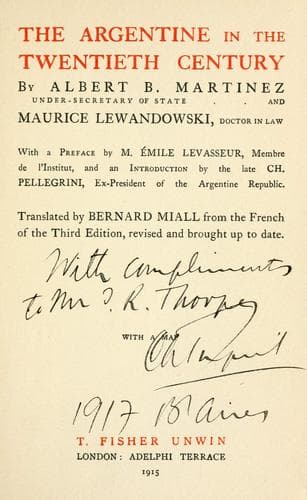
The Argentine in the Twentieth CenturyMartínez, Alberto B.
History
The Argentine in the Twentieth Century
Martínez, Alberto B.
Argentina -- Commerce; Argentina -- Economic conditions; Finance -- Argentina
In June 1885 the premium rose to 50 per cent.; in 1886, it was 39 per
cent.; in 1887, 35 per cent.; in July 1888 53 per cent., finally, in
1889, it proceeded by leaps and bounds; 50 per cent. in January, it was
53 per cent. a month later; in March it was 55 per cent., rising to 120
per cent. in September and October, and 130 per cent. in November and
December, despite the empirical measures of alleviation adopted, amid
violent disputes, by the Minister of Finance.
Thus the Republic entered on the year 1890; a year of grave political
and financial disaster. On the one hand was the revolutionary movement,
prepared by the connivance of part of the army and the navy; on the
other hand, the crushing depreciation of paper, ending in an absolute
catastrophe which affected both public and private fortunes.
In the month of April of that year the premium increased to 215 per
cent.; that is, 100 piastres in gold were equivalent to 315 in paper.
In July, when the revolution broke out, it stood at 217 per cent. In
November the Government which replaced that which had been attacked
by the insurgents prohibited the quotation of gold. Nevertheless, the
premium rose to 225 per cent, and remained at that figure until December.
We must remember that, in spite of the downfall of paper, the economic
vitality of the Republic had suffered no serious blow; no war had broken
out, no international complication had occurred; there was, in short,
no organic cause to which the premium could be attributed. Certainly,
the commercial balance was unfavourable; but that phenomenon has not the
significance generally attributed to it. The true causes of this crushing
state of affairs were exclusively of a financial and administrative
nature. It was the inevitable result of the manner in which paper money
had been issued to serve the needs of the Government, and to feed the
furnace of speculation. One cannot forget that at the end of 1886 the
total issue of paper amounted to $80,251,380; that in less than two years
it was nearly doubled, amounting to $147,503,911; while in 1890 the paper
currency reached the figure of $196,882,500. But this situation, painful
as it was, could not be suddenly changed for the better; other causes of
a like nature were about to intensify it. The new President, who came
into power after the revolutionary outbreak found himself forced, by
various circumstances, to increase the existing circulation of paper.
The new issues amounted to $150,000,000.
As was only to be expected, such an issue on the back of the existing
paper currency, which exceeded $196,000,000, could only produce a
disastrous fall in paper. Its depreciation touched the lowest point in
the history of the Argentine, or of any other country during the second
half of the nineteenth century; the blackboard of the Stock Exchange
showed an exchange value of 464 per cent. or a premium of 364 per cent.,
in the third week of October 1891. This was the record of monetary
depreciation.
Public-domain text, read in full here on John Shaqi.
Reviews
Reviews
No reviews yet
Be the first to share your thoughts on this work.
Elsewhere in the archive
Join the Discussion
Join the discussion
Sign in to leave a comment or review.
Sign InorCreate an account