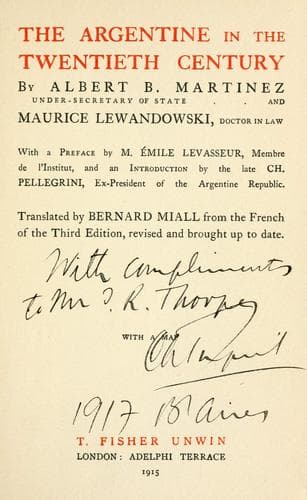
The Argentine in the Twentieth CenturyMartínez, Alberto B.
History
The Argentine in the Twentieth Century
Martínez, Alberto B.
Argentina -- Commerce; Argentina -- Economic conditions; Finance -- Argentina
What, for example, were the reasons which determined the premium on
gold in 1885, under the first Presidency of General Roca? Was it, by
any chance, that any economic calamity fell upon the country? Were
the harvests lost? or was there a foreign war, or even one of those
revolutionary risings so common among the South American nations? Did the
germs of some epidemic invade the country, decimating the population by
disease and poverty? Was there any violent and ruinous fall in the market
prices of Argentine products?
Nothing of the kind befell. The Government itself, in the message in
which it solicited the ratification of the double standard, that “the
national production, the valuation and the degree of culture of the
soil, had consolidated the national credit.” The crops were abundant;
and their prices, in foreign markets, were more than fair. The Republic
was at peace, at home and abroad; thus realising one of the dreams of
the paternal administration which directed its destinies. As for the
public health, it suffered no perceptible eclipse in all the Argentine
Territory.
It has also been said that the commercial balances were unfavourable to
the Argentine: a country at once a debtor and a centre of immigration.
And it has been asserted, too, that the Republic suffered from a sudden
increase of growth, without having behind it any reserves of accumulated
capital.
The affirmation that the depreciation of the currency, and in consequence
the establishment of a double standard, arose from unfavourable
commercial balances, has no scientific basis and is not supported by
precise demonstration.
“None of the countries which have suffered the misfortune of a
depreciated currency have reached that condition purely on account
of adverse balances,” as a Spanish economist, Señor Edouardo Sans y
Escartin, has said with justice. All countries have suffered from this
evil, on account of monetary changes, and the Argentine is only the
latest example. France towards the end of the eighteenth century, England
from 1797 to 1821, Austria and Russia since the beginning of the last
century, the United States from 1862 to 1878, Italy since 1875, Paraguay
since 1870, and the Hispano-American Republics for the last twenty-five
years: all these countries have suffered from monetary perturbations,
some through the abuse of paper money or the excess of the fiduciary
circulation, others through the variations of the relation of gold to
silver. In none of these countries did the crisis take the form of the
consequence of unfavourable commercial balances.
We find, in fact, that it is not the case that economic causes, resulting
either from the formative period the country has traversed, or from its
lack of accumulated capital, have contributed and are still contributing
in the Argentine Republic to prolong the system of inconversion; the
causes are exclusively financial and administrative, as we have already
maintained.[109]
Public-domain text, read in full here on John Shaqi.
Reviews
Reviews
No reviews yet
Be the first to share your thoughts on this work.
Elsewhere in the archive
Join the Discussion
Join the discussion
Sign in to leave a comment or review.
Sign InorCreate an account