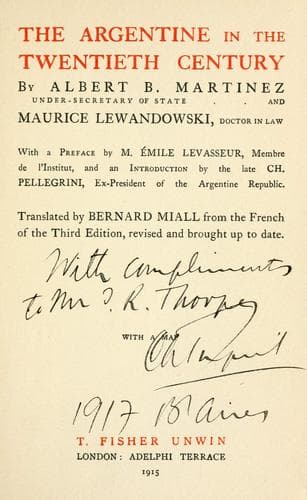
The Argentine in the Twentieth CenturyMartínez, Alberto B.
History
The Argentine in the Twentieth Century
Martínez, Alberto B.
Argentina -- Commerce; Argentina -- Economic conditions; Finance -- Argentina
After 1892 the monthly quotation of gold, in relation to paper,
oscillated between 359 and 290 in 1893; 433 and 307 in 1894; 377 and 311
in 1895; 352 and 266 in 1896; 317 and 274 in 1897.
We see from these figures that these conditions are abnormal,
extraordinary; and yet, owing to their long duration, they are almost
part of the normal life of the Republic. It is therefore a matter of
interest to study the causes of such phenomena, in order to decide
whether they are inherent in the period of transformation through which
the country is passing, in which case it would be idle to attempt any
reform at present, or whether they can be controlled or checked by the
employment of means counselled by science and confirmed by experience.
According to the judgment of certain persons who have devoted themselves
to the study of economic questions, the causes which, in the Republic,
produce the double standard, are of a permanent character, proper to the
period of formation through which the country is passing. It is even
said that so long as Argentina has not a capital of her own with which
to float herself in the full tide of affairs——such a capital as is the
result of years or centuries of prosperity——so long will she be a debtor
among the nations, and the system of the double currency must continue.
We ourselves are of opinion that the causes which have produced, and
now maintain the inconversion of the fiduciary currency, are of a very
different character to those implied by the above judgment; and that if
we consider the economic state of the country at the moment when the
double standard was established, we shall find that it was in no way
responsible for the phenomenon of depreciated currency. The true cause is
the necessities of the Government; determined either by factors beyond
the range of debate, such, for example, as the eventuality of a foreign
war, or by less justifiable reasons, such as deficits in the budget and
reckless issues of paper. In both cases the printing-presses of the
official banks have been set to work, in order to tide the Government
over a difficult passage, at the risk of vitiating the instrument of
national credit by the efflux of inconvertible paper.
Those interested should read the history of the first issues, exposed in
a masterly manner by Señor Augustin de Vedia, in his work on the National
Bank; they will see that the excessive issue of notes cannot be explained
or justified by the period of economic formation which the country has
passed through. We must search for other causes in order to explain this
long and unfortunate period of inconversion, which lasted, with a few
years’ respite; from 1820 down to 1905.
Public-domain text, read in full here on John Shaqi.
Reviews
Reviews
No reviews yet
Be the first to share your thoughts on this work.
Elsewhere in the archive
Join the Discussion
Join the discussion
Sign in to leave a comment or review.
Sign InorCreate an account