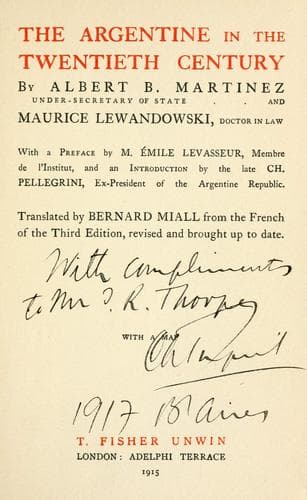
The Argentine in the Twentieth CenturyMartínez, Alberto B.
History
The Argentine in the Twentieth Century
Martínez, Alberto B.
Argentina -- Commerce; Argentina -- Economic conditions; Finance -- Argentina
[Footnote 111: As the _Annuaire statistique_ declares, in the course of
the year 1908 no less than £8,160,000 changed hands over the sale and
purchase of lottery tickets and betting on racehorses. This is an evil
that may grow into a national calamity if nothing is done to arrest it;
and we see with pleasure that the Government has stated its intention of
presenting to Congress the draft of a law prohibiting lotteries.]
This law also provided for the formation of a Conversion Fund, which
was a powerful factor——_si vis pacem para bellum_——in the pacific
solution of the old frontier dispute with Chili. This fund amounts
to-day to £5,100,000 deposited in the Bank of the Nation, and would,
without this far-sighted law, have been swallowed up in the whirlpool of
administrative expenses.
Lastly, the law of monetary conversion has been the salvation of
agriculture and stock-raising, the two chief sources of national wealth,
by preventing the too rapid change in the value of paper, which is
a result that deserves to be considered with attention. The law was
promulgated at a time when a large harvest was expected, and when, from
that very cause, the depreciation of paper violently increased, the value
falling from 278 in August 1898 to 206 in December of the same year. It
is certain that at this rate the depreciation would finally have touched
150, to the greater profit of the speculators.
What would have happened had the monetary situation altered so
rapidly? The Argentine agriculturalist or stock-raiser, having paid
all the expenses of production with gold at about 300 per cent., would
have been forced, by reason of the rapid depreciation of paper, to
sell his products at a price which would no longer compensate him
for his increased expenditure. This would inevitably have ruined the
producer——that is, the principal artisan of the national fortune. Far
from opening up new lands with his ploughshare, as hitherto had always
been the case, he would have abandoned the land already under cultivation.
We need not describe the disaster which would have overcome the country
under such conditions as these: the loss of credit both at home and
abroad. The stream of immigration would have been suspended; emigration,
on the contrary, would have increased, taking the form of a veritable
exodus, even of a flight; and each impoverished and disillusioned
emigrant, as he left the Argentine, would have proclaimed that the
country was ruined. As a result the Argentine would have been for years
partially depopulated, or at least deprived of the new recruits which
immigration brings in, and of whom it has such need in order to realise
the value of more virgin territory.
Public-domain text, read in full here on John Shaqi.
Reviews
Reviews
No reviews yet
Be the first to share your thoughts on this work.
Elsewhere in the archive
Join the Discussion
Join the discussion
Sign in to leave a comment or review.
Sign InorCreate an account