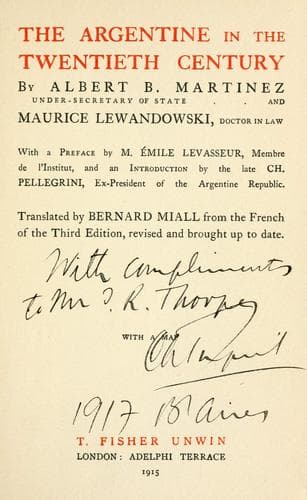
The Argentine in the Twentieth CenturyMartínez, Alberto B.
History
The Argentine in the Twentieth Century
Martínez, Alberto B.
Argentina -- Commerce; Argentina -- Economic conditions; Finance -- Argentina
Worse still: once the harvest was sold, at prices which could no longer
be calculated on the basis of the cost, gold, now freed from all
restraint, like a balloon whose mooring is broken, would have resumed
its upward journey. The melancholy spectacle of 1890 and 1891 would
have been repeated; gold would have risen by leaps and bounds, in
contradictory and incalculable rushes, finally to reach the limits that
mean bankruptcy.[112]
[Footnote 112: We remember that gold, which on the 9th of August 1890
stood at 35 per cent. when a new Government came into power, had risen
to 425 per cent. by May 1891, and in October of the same year touched
464 per cent.; the highest premium ever known in the long history of the
double standard during the last half of the nineteenth century. In the
United States during the war of secession, the premium on gold rose to
286 per cent. only (on July the 4th 1864).]
Such are the disastrous results which would have ensued had not the
law of monetary conversion come just in time to restrain the rapid
depreciation of paper, and to give money the stability it must possess
if it is to be the faithful and precise instrument of commercial
transactions, the common measure of all exchanges. Such were the
beneficent results which followed shortly upon the operation of the
law; and we can only regret that it has not always been understood and
applied with sufficient force by those who were responsible for putting
it into practice. The Governments which have followed since then have not
always followed the ideal of economy and scrupulous administration which
should ensure the success of this important reform. None the less, the
Conversion Fund amounts to-day to £5,100,000.
According to the figures for October 1909 the monetary situation of the
country may be summed up as follows:——
The total of notes in circulation amounts to $686,291,704 paper,
equivalent to £60,393,670. The Conversion Fund of £5,100,000 in gold,
added to £34,752,058 on deposit in the _Caisse de Conversion_ and to the
£14,073,515 deposited in the various banks of the capital, forms a total
of £53,925,573. It follows from these eloquent figures that the fiduciary
circulation, notes, nickel, and copper, is guaranteed in Argentina by
an actual value of 65.9 per cent. of its total; the notes alone are
guaranteed by 89 per cent. of gold.
Unquiet spirits from time to time, including the enemies of monetary
reform, announce their opinion in the press that this law should be
modified. Quite lately the well-known journal _La Nacion_, which is
distinguished by the constancy and fervour with which it attacks this
beneficent measure, has opened its columns to an enquiry, in order to
obtain the opinion of the public, or at least of persons competent in
such matters. Happily common-sense triumphed; the law remains intact,
continuing to benefit the whole national economy.
CHAPTER IV
THE _CAISSE DE CONVERSION_
Public-domain text, read in full here on John Shaqi.
Reviews
Reviews
No reviews yet
Be the first to share your thoughts on this work.
Elsewhere in the archive
Join the Discussion
Join the discussion
Sign in to leave a comment or review.
Sign InorCreate an account