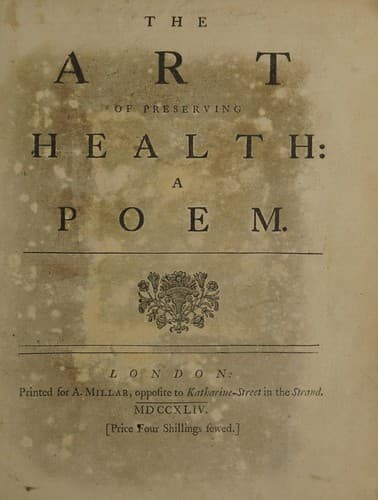
The art of preserving health: A poemArmstrong, John
Philosophy
The art of preserving health: A poem
Armstrong, John
Health -- Early works to 1800; Health -- Poetry; Hygiene -- Early works to 1800; Hygiene -- Poetry
The body moulded by the clime, indures
Th’ Equator heats, or Hyperborean frost:
Except by habits foreign to its turn, 285
Unwise, you counteract its forming pow’r.
Rude at the first, the winter shocks you less
By long acquaintance: Study then your sky,
Form to its manners your obsequious frame,
And learn to suffer what you cannot shun. 290
Against the rigors of a damp cold heav’n
To fortify their bodies, some frequent
The gelid cistern; and, where nought forbids,
I praise their dauntless heart. A frame so steel’d
Dreads not the cough, nor those ungenial blasts, 295
That breathe the Tertian or fell Rheumatism;
The nerves so temper’d never quit their tone,
No chronic languors haunt such hardy breasts.
But all things have their bounds: And he who makes
By daily use the kindest regimen 300
Essential to his health, should never mix
With human kind, nor art nor trade pursue.
He not the safe vicissitudes of life
Without some shock endures; ill-fitted he
To want the known, or bear unusual things. 305
Besides, the powerful remedies of pain
(Since pain in spite of all our care will come)
Should never with your prosperous days of health
Grow too familiar: For by frequent use
The strongest medicines lose their healing power, 310
And even the surest poisons theirs to kill.
Let those who from the frozen Arctos reach
Parch’d Mauritania, or the sultry West,
Or the wide flood that waters Indostan,
Plunge thrice a day, and in the tepid wave 315
Untwist their stubborn pores; that full and free
Th’ evaporation thro’ the softned skin
May bear proportion to the swelling blood.
So shall they ’scape the fever’s rapid flames;
So feel untainted the hot breath of hell. 320
With us, the man of no complaint demands
The warm ablution, just enough to clear
The sluices of the skin, enough to keep
The body sacred from indecent soil.
Still to be pure, even did it not conduce 325
(As much it does) to health, were greatly worth
Your daily pains. ’Tis this adorns the rich;
The want of this is poverty’s worst woe:
With this external virtue, age maintains
A decent grace; without it, youth and charms 330
Are loathsome. This the skilful virgin knows:
So doubtless do your wives. For married sires,
As well as lovers, still pretend to taste;
Nor is it less (all prudent wives can tell)
To lose a husband’s, than a lover’s heart. 335
Public-domain text, read in full here on John Shaqi.
Reviews
Reviews
No reviews yet
Be the first to share your thoughts on this work.
Join the Discussion
Join the discussion
Sign in to leave a comment or review.
Sign InorCreate an account