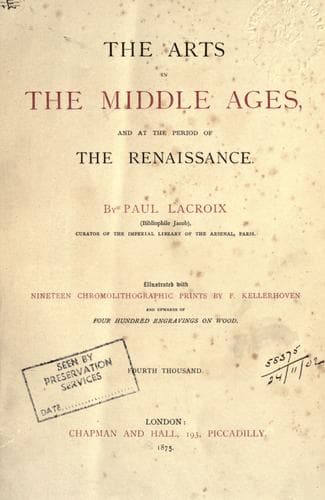
The Arts in the Middle Ages and at the Period of the RenaissanceJacob, P. L.
History
The Arts in the Middle Ages and at the Period of the Renaissance
Jacob, P. L.
Art, Medieval; Art, Renaissance; Middle Ages
Charlemagne. It is to Henry that the Cathedral of Basle owes the
decorations of the altar, to which none can be compared for richness,
except that of Milan; yet without recalling it by its style, which has
lost every trace of the antique, and is a clearly-pronounced type of the
art which the Middle Ages were to create as their own. It is right to
mention also the crown of the sainted emperor, and that of his wife, now
preserved in the Treasury of the King of Bavaria; both are in six
jointed parts, making a circle; the former bears figures of winged
angels; the other, stalks with four leaves designed with correctness and
grace, and executed in a manner which evinces the greatest dexterity.
“Moreover,” says M. Labarte, “the taste for jewellery was then generally
diffused throughout Germany; and many prelates followed the example set
by the emperor. Willigis, the first Archbishop of Mayence, may be cited;
he endowed his church with a crucifix weighing 600 pounds, the several
parts of which were adjusted with such art that each could be detached
at the joints; and Bernward, Bishop of Hildesheim, who, like St. Eloi,
was himself a celebrated goldsmith, and to whom is ascribed a crucifix
enriched with precious stones and filigrees, and two magnificent
candelabra, which still constitute a portion of the treasures of the
church whereof he was the pastor.”
About the same period--that is, in the early days of the eleventh
century--a monk of Dreux, named Odorain, who had made himself famous in
France by his works in precious metals, executed a large number of
objects for King Robert, intended for the churches the monarch had
founded.
[Illustration: Fig. 92.--Shrine in Copper Gilt. (End of the Twelfth
Century.)]
It has been remarked in the preceding chapter, that the Crusades gave a
great impulse to the goldsmith’s art in Europe, in consequence of the
great demand for shrines and reliquaries intended for the reception of
the venerated remains of saints which the soldiers of the faith brought
back from their distant expeditions (Figs. 91 and 92). The offerings of
consecrated vessels and of altar-fronts were also multiplied. The Holy
Scriptures received cases and coverings which were so many splendid
works entrusted to the goldsmiths. To speak truly, had it not been for
the essentially religious direction which, at that period, certain
departments of luxury acquired by the Crusaders in the East had taken,
we might perhaps have seen the arts, that only in the West recommenced
a real existence, become extinguished, and in a manner perish in the
first burst of their revival.
It is chiefly to the minister of Louis le Gros, Suger, Abbot of
Saint-Denis, who died in 1152, that the honour of this consecration of
arts is due, for he distinctively proclaimed himself their protector; he
endeavoured to render legitimate their position in the State, by
opposing their pious aims to the too exclusive censures of St. Bernard
and his disciples.
Public-domain text, read in full here on John Shaqi.
Reviews
Reviews
No reviews yet
Be the first to share your thoughts on this work.
Elsewhere in the archive
Join the Discussion
Join the discussion
Sign in to leave a comment or review.
Sign InorCreate an account