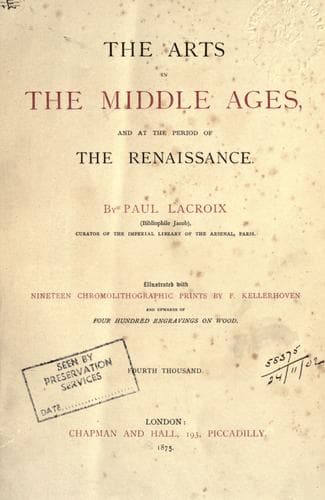
The Arts in the Middle Ages and at the Period of the RenaissanceJacob, P. L.
History
The Arts in the Middle Ages and at the Period of the Renaissance
Jacob, P. L.
Art, Medieval; Art, Renaissance; Middle Ages
Conjointly with the powerful abbot, there is deserving of special
mention a simple monk, Theophilus, an eminent artist who wrote in Latin
a description of the Industrial Arts of his time (_Diversarum Artium
Schedula_), and devoted seventy-nine chapters of his book to that of the
goldsmith. This valuable treatise shows us, in the most unmistakable
manner, that the goldsmiths of the twelfth century must have possessed a
comprehensiveness of knowledge and manipulation, the mere enumeration of
which surprises us the more now that we see industry everywhere tending
to an almost infinite division of labour. At that time the goldsmith was
required to be at once modeller, sculptor, smelter, enameller,
jewel-mounter, and inlay-worker. He had to cast his own models in wax,
as well as to labour with his hammer or embellish with his graver: he
had to make the chalice, the vases, and the pyx, for the metropolitan
churches, on which were lavished all the resources of art; and to
produce, by the ordinary process of punching, the open-work or the
designs of copper intended to ornament the books of the poor (_libri
pauperum_), &c.
The treasury of the Abbey of Saint-Denis still possessed, at the time of
the Revolution, several _chefs-d’œuvre_ produced by the artists whose
processes are described by Theophilus; especially the rich mounting of a
cup of Oriental agate, bearing the name of Suger, which it is believed
he used for the service of mass; and the mounting of an ancient sardonyx
vase, known as the cup of the Ptolemies, which Charles the Simple had
given to the abbey. Having been deposited, in 1793, in the Cabinet of
Medals, Paris, the mounting of the cup of the Ptolemies and the chalice
of Suger remained there until they were stolen in 1804.
Among the examples of that period still existing, and which,
conditionally, every one is permitted to inspect, we may distinguish,
with M. Labarte,--in addition to “the great crown of lights” suspended
under the cupola in the cathedral of Aix-la-Chapelle, and the
magnificent shrine in which Frederick I. collected the bones of
Charlemagne,--in the Museum of the Louvre, a vase of rock-crystal
mounted in gold and embellished with gems, presented to Louis VII. by
his wife Eleanora; in the Cluny Museum, several candelabra; in the
Imperial Library in Paris, the covering of a Latin manuscript, numbered
622; a cup of agate onyx (Fig. 93), bordered with a belt of precious
stones raised on a groundwork of filigree; and the beautiful gold
chalice of St. Remy (Fig. 94), which, after having appeared in the
Cabinet of Antiquities, was restored in 1861 to the treasury of the
church of Notre-Dame, Rheims.
Public-domain text, read in full here on John Shaqi.
Reviews
Reviews
No reviews yet
Be the first to share your thoughts on this work.
Elsewhere in the archive
Join the Discussion
Join the discussion
Sign in to leave a comment or review.
Sign InorCreate an account