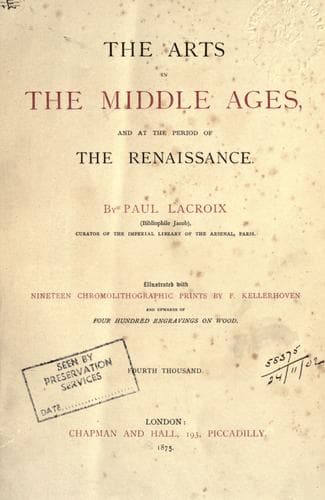
The Arts in the Middle Ages and at the Period of the RenaissanceJacob, P. L.
History
The Arts in the Middle Ages and at the Period of the Renaissance
Jacob, P. L.
Art, Medieval; Art, Renaissance; Middle Ages
Severe forms and an elevated style were the characteristics of the
jewelled works of the eleventh and twelfth centuries; and, for the
principal elements of accessory embellishment, we most frequently see
pearls, precious stones, with enamelled divisions which, according to
the minute description of Theophilus, are only delicate mosaics whose
various coloured segments are separated by plates of gold.
[Illustration: Fig. 93.--A Drinking Cup, called Gondole, of Agate; from
the Treasury of the Abbey of Saint-Denis. (Cabinet of Antiquities, Imp.
Library, Paris.)]
In the days of St. Louis, a period of active and generous piety, there
was (an assertion which may appear hazardous after what we have said of
the zeal of preceding centuries) a remarkable accession to the number
and the splendour of the gifts and offerings of jewellery to the
churches. For instance, it was then that Bonnard, Parisian goldsmith,
assisted by the ablest artisans, devoted two years to the manufacture of
the shrine of
[Illustration: Fig. 94.--Chalice, said to be of St. Remy. (Treasury of
the Cathedral of Rheims.)]
St. Geneviève, on which he expended one hundred and ninety-three marks
of silver and seven and a half marks of gold; the mark weighing eight
ounces. The shrine, consecrated in 1212, was in the form of a little
church, with statuettes and bas-reliefs enriched with precious stones.
It was deposited in the French mint in 1793; but the spoil realised only
twenty-three thousand eight hundred and thirty livres. Half a century
earlier, the most celebrated German goldsmiths were engaged during
seventeen years upon the famous reliquary in silver gilt, called the
“Great Relics,” which the cathedral at Aix-la-Chapelle still possesses;
it was fabricated from the gifts deposited in that space of time by the
faithful in the poors’-box of the porch; an edict of the Emperor
Barbarossa having appropriated all the offerings to that object, “so
long as it remained unfinished.”
Public-domain text, read in full here on John Shaqi.
Reviews
Reviews
No reviews yet
Be the first to share your thoughts on this work.
Elsewhere in the archive
Join the Discussion
Join the discussion
Sign in to leave a comment or review.
Sign InorCreate an account