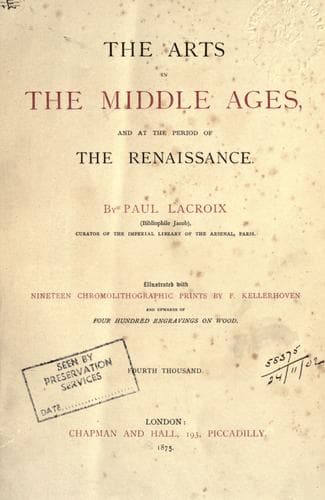
The Arts in the Middle Ages and at the Period of the RenaissanceJacob, P. L.
History
The Arts in the Middle Ages and at the Period of the Renaissance
Jacob, P. L.
Art, Medieval; Art, Renaissance; Middle Ages
Modes of measuring Time among the Ancients.--The Gnomon.--The
Water-Clock.--The Hour-Glass.--The Water-Clock, improved by the
Persians and by the Italians.--Gerbert invents the Escapement and
the moving Weights.--The Striking-bell.--Maistre Jehan des
Orloges.--Jacquemart of Dijon.--The first Clock in Paris.--Earliest
portable Timepiece.--Invention of the spiral Spring.--First
appearance of Watches.--The Watches, or “Eggs,” of
Nuremberg.--Invention of the Fusee.--Corporation of
Clockmakers.--Noted Clocks at Jena, Strasburg, Lyons,
&c.--Charles-Quint and Jannellus.--The Pendulum.
Among the ancients there were three instruments for measuring time--the
_gnomon_, or sun-dial, which is only, as we know, a table whereon lines
are so arranged as successively to meet the shadow cast by a gnomon,[20]
thus indicating the hour of the day according to the height or
inclination of the sun; the water-clock (_clepsydra_), which had for its
principle the measured percolation of a certain quantity of water; and
the hour-glass, wherein the liquid is exchanged for sand. It would be
difficult to determine which of these three chronometric modes can lay
claim to priority. There is this to be said that, according to the
Bible, in the eighth century before Christ, Ahaz, King of Judah, caused
a sun-dial to be constructed at Jerusalem; again, Herodotus says
Anaximander introduced the sun-dial into Greece, whence it passed on to
the other parts of the then civilised world; and that, in the year 293
before our era, the celebrated Papirius Cursor, to the astonishment of
his fellow-citizens, had a sun-dial traced near the temple of Jupiter
Quirinus.
According to the description given by Athena (Athenæus?), the
water-clock was formed of an earthenware or metal vessel filled with
water, and then suspended over a reservoir whereon lines were marked
indicating the hours, as the water which escaped drop by drop from the
upper vessel came to the level. We find this instrument employed by most
ancient nations, and in many countries it remained in use until the
tenth century of the Christian era.
[Illustration: Fig. 143.--The Clockmaker. Designed and Engraved by J.
Amman.]
Public-domain text, read in full here on John Shaqi.
Reviews
Reviews
No reviews yet
Be the first to share your thoughts on this work.
Elsewhere in the archive
Join the Discussion
Join the discussion
Sign in to leave a comment or review.
Sign InorCreate an account