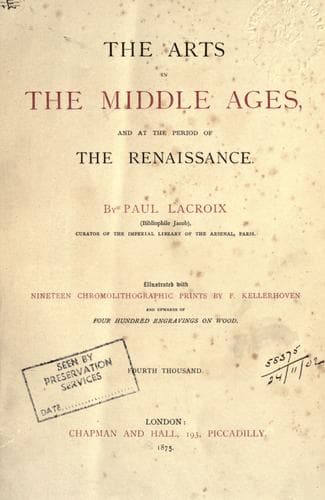
The Arts in the Middle Ages and at the Period of the RenaissanceJacob, P. L.
History
The Arts in the Middle Ages and at the Period of the Renaissance
Jacob, P. L.
Art, Medieval; Art, Renaissance; Middle Ages
In one of his dialogues Plato declares that the philosophers are far
more fortunate than the orators--“these being the slaves of a miserable
water-clock; whereas the others are at liberty to make their discourse
as long as they please.” To explain this passage, we must remember that
it was the practice in the Athenian courts of justice, as subsequently
in those of Rome, to measure the time allowed to the advocates for
pleading by means of a water-clock. Three equal portions of water were
put into it--one for the prosecutor, one for the defendant, and the
third for the judge. A man was charged with the special duty of giving
timely notice to each of the three speakers that his portion was nearly
run out. If, on some unusual occasion, the time for one or other of the
parties was doubled, it was called “adding water-clock to water-clock;”
and when witnesses were giving evidence, or the text of some law was
being read out, the percolation of the water was stopped: this was
called _aquam sustinere_ (to retain the water).
The hour-glass, which is still in use to a considerable extent for
measuring short intervals of time, had great analogy with the
water-clock, but was never susceptible of such regularity. In fact, at
different periods important improvements were applied to the
water-clock. Vitruvius tells us that, about one hundred years before our
era, Ctesibius, a mechanician of Alexandria, added several cogged-wheels
to the water-clock, one of which moved a hand, showing the hour on a
dial. This must have been, so far as historical documents admit of
proof, the first step towards purely mechanical horology.
In order, then, to find an authentic date in the history of horology, we
must go to the eighth century, when water-clocks, still further
improved, were either made or imported into France; among others, one
which Pope Paul I. sent to Pepin le Bref. We must, however, believe that
these instruments can have attracted but little attention, or that they
were speedily forgotten; for, one hundred years later, there appeared a
water-clock at the court of Charlemagne, a present from the famous
caliph Aroun-al-Raschid, regarded, indeed almost celebrated, as a
notable event. Of this Eginhard has left us an elaborate description. It
was, he says, in brass, damaskeened with gold, and marked the hours on a
dial. At the end of each hour an equal number of small iron balls fell
on a bell, and made it sound as many times as the hour indicated by the
needle. Twelve windows immediately opened, out of which were seen to
proceed the same number of horsemen armed _cap-à-pie_, who, after
performing divers evolutions, withdrew into the interior of the
mechanism, and then the windows closed.
Public-domain text, read in full here on John Shaqi.
Reviews
Reviews
No reviews yet
Be the first to share your thoughts on this work.
Elsewhere in the archive
Join the Discussion
Join the discussion
Sign in to leave a comment or review.
Sign InorCreate an account