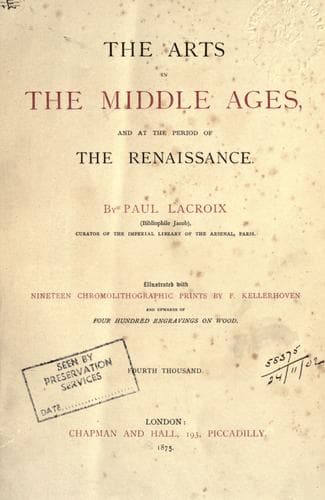
The Arts in the Middle Ages and at the Period of the RenaissanceJacob, P. L.
History
The Arts in the Middle Ages and at the Period of the Renaissance
Jacob, P. L.
Art, Medieval; Art, Renaissance; Middle Ages
Among the most remarkable clocks of that period, we must refer to that
of which Froissart speaks, and which was carried away from the town of
Courtray by Philip the Bold after the battle of Rosbecque in 1382. “The
Duke of Burgundy,” says our author, “caused to be carried away from the
market-place a clock that struck the hours, one of the finest which
could be found on either side the sea; and he conveyed it piece by piece
in carts, and the bell also. Which clock was brought and carted into the
town of Dijon, in Burgundy, was there deposited and put up, and there
strikes the twenty-four hours between day and night.”
It is the celebrated clock of Dijon which then as now was surmounted by
two automata of iron, a man and a woman, striking the hours on the bell.
The origin of the name of _Jacquemart_ given to these figures has been
much disputed. Ménage believes that the word is derived from the Latin
_jaccomarchiardus_ (coat of mail--attire of war); and he reminds us
that, in the Middle Ages, it was the custom to station, on the summit of
the towers, men (soldiers wearing the _jacque_) to give warning of the
approach of the enemy, of fires, &c. Ménage adds that, when more
efficient watchers occasioned the discontinuance of these nocturnal
sentinels, it was probably considered desirable to preserve the
remembrance of them by putting in the place they had occupied iron
figures which struck the hours. Other writers trace the name even to the
inventor of this description of clocks, who, according to them, lived in
the fourteenth century, and was called Jacques Marck. Finally, Gabriel
Peignot, who has written a dissertation on the _jacquemart_ of Dijon,
asserts that in 1422 a person named Jacquemart, clockmaker and
locksmith, residing in the town of Lille, received twenty-two livres
from the Duke of Burgundy, for repairing the clock of Dijon; and from
that he concludes, seeing how short the distance is from Lille to
Courtray, whence the clock of Dijon had been taken, that this Jacquemart
might well be the son or the grandson of the clockmaker who had
constructed it about 1360; consequently the name of the _jacquemart_ of
Dijon is derived from that of its maker, old Jacquemart, the clockmaker
of Lille (Fig. 145).
[Illustration: Fig. 145.--Jacquemart of Notre-Dame at Dijon, made at
Courtray in the Fourteenth Century.]
Giving to each of these opinions its due weight, we confine ourselves to
stating that, from the end of the fourteenth century to the beginning
of the fifteenth, numerous churches in Germany, Italy, and France
already had _jacquemarts_.
The first clock possessed by Paris was that in the turret of the Palais
de Justice. Charles V. had it constructed in 1370 by a German artisan,
Henri de Vic. It contained a weight for moving power, an oscillating
piece for regulator, and an escapement. It was adorned with carvings by
Germain Pilon, and was destroyed in the eighteenth century.
Public-domain text, read in full here on John Shaqi.
Reviews
Reviews
No reviews yet
Be the first to share your thoughts on this work.
Elsewhere in the archive
Join the Discussion
Join the discussion
Sign in to leave a comment or review.
Sign InorCreate an account