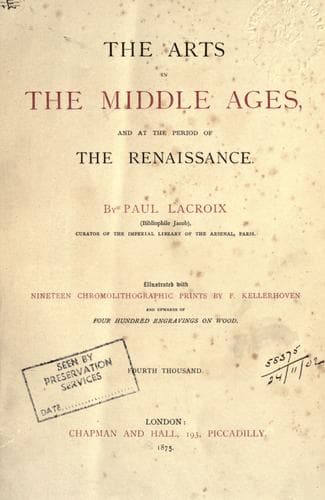
The Arts in the Middle Ages and at the Period of the RenaissanceJacob, P. L.
History
The Arts in the Middle Ages and at the Period of the Renaissance
Jacob, P. L.
Art, Medieval; Art, Renaissance; Middle Ages
To give an idea of what was effected at that time, we will borrow a
passage from the earliest writings in which horology is mentioned; that
is, from an unpublished book by Philip de Maizières, entitled “Le Songe
du Vieil Pélerin:”--“It is known that in Italy there is at present
(about 1350) a man generally celebrated in philosophy, in medicine, and
in astronomy; in his station, by common report, singular and grave,
excelling in the above three sciences, and of the city of Padua. His
surname is lost, and he is called ‘Maistre Jehan des Orloges,’ residing
at present with the Comte de Vertus; and, for the treble sciences, he
has for yearly wages and perquisites two thousand florins, or
thereabouts. This Maistre Jean des Orloges has made an instrument, by
some called a _sphere_ or clock, of the movement of the heavens, in
which instrument are all the motions of the signs (zodiacal), and of the
planets, with their circles and epicycles, and multiplied differences,
wheels (_roes_) without number, with all their parts, and each planet in
the said sphere, distinctly. On any given night, we see clearly in what
sign and degree are the planets and the stars of the heavens; and this
sphere is so cunningly made, that notwithstanding the multitude of
wheels, which cannot well be numbered without taking the machinery to
pieces, their entire mechanism is governed by one single counterpoise,
so marvellous that the grave astronomers from distant regions come with
great reverence to visit the said Maistre Jean and the work of his
hands; and all the great clerks of astronomy, of philosophy, and of
medicine, declare that there is no recollection of a man, either in
written document or otherwise, who in this world has made so ingenious
or so important an instrument of the heavenly movements as the said
clock.... Maistre Jean made the said clock with his own hands, all of
brass and of copper, without the assistance of any other person, and did
nothing else during sixteen entire years, if the writer of the book, who
had a great friendship for the said Maistre Jean, has been rightly
informed.”
It is known, on the other hand, that the famous clockmaker, whose real
name Maizières assumes to be lost, was called Jaques de Dondis; and
that, in spite of the assertion of the writer, he had only to arrange
the clock, the parts of which had been executed by an excellent workman
named Antoine. However this may be, placed at the top of one of the
towers of the palace of Padua, the clock of Jaques de Dondis, or of
“Maistre Jean des Orloges,” excited general admiration, and several
princes of Europe being desirous to have similar clocks, many workmen
tried to imitate it. In fact, churches or monasteries were soon able to
pride themselves on possessing similar _chefs-d’œuvre_.
Public-domain text, read in full here on John Shaqi.
Reviews
Reviews
No reviews yet
Be the first to share your thoughts on this work.
Elsewhere in the archive
Join the Discussion
Join the discussion
Sign in to leave a comment or review.
Sign InorCreate an account