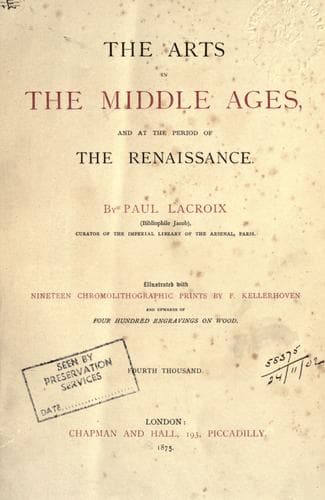
The Arts in the Middle Ages and at the Period of the RenaissanceJacob, P. L.
History
The Arts in the Middle Ages and at the Period of the Renaissance
Jacob, P. L.
Art, Medieval; Art, Renaissance; Middle Ages
It may be conceived that all these complicated works required numerous
craftsmen. It was therefore considered proper to unite these artisans in
a community. The statutes which they had received from Louis XI. in 1483
were confirmed by Francis I. They contained a succession of laws,
intended to protect at the same time the interests of members of the
corporation and the dignity of their profession.
No one was admitted as master but on proof of having served eight years
of apprenticeship, and after having produced a _chef-d’œuvre_ in the
[Illustration: CLOCK OF DAMASCENED IRON AND WATCHES Of the Fifteenth and
Sixteenth Centuries.]
house, or under the supervision, of one of the inspectors of the
corporation. The visiting inspectors, elected by all the members, as
well as by the trustees and the syndics, were authorised when
introducing themselves into the workshops, to look after the proper
construction of watches and clocks; and if it happened that they found
such as did not appear to be made according to the rules of art, they
could not only seize and destroy them, but also impose a fine on the
maker for the benefit of the corporation. The statutes also gave
exclusive right to the accredited masters to trade, directly or
otherwise, with all the stock, new or second-hand, finished or
unfinished.
[Illustration: Figs. 148 to 150.--Watches of the Valois Epoch.
(Sixteenth Century.)]
“Under the influence of these wise institutions,” M. Dubois remarks,
“the master-clockmakers had no fear of the competition of persons not
belonging to the corporation. If they were affected by the artistic
superiority of some of their colleagues, it was with the laudable desire
to contend with them for the first places. The work of one day, superior
to that of the preceding, was surpassed by that of the day following. It
was by this incessant competition of intelligence and knowledge, by this
legitimate and invigorating rivalry of all the members of the same
industrious community, that science itself attained by degrees the
zenith of the excellent and the sublime of the beautiful. The ambition
of workmen was to rise to the mastership, and they attained that only by
force of labour and assiduous efforts. The ambition of the masters was
to acquire the honours of the syndicate--that consular magistracy the
most honourable of all, for it was the result of election, and the
recompense of services rendered to art and to the community.”
Having thus reached the middle of the sixteenth century, and not wishing
to exceed the compass assigned to this sketch, we may limit ourselves to
the mention of some of the remarkable works produced during a century by
an art that had already manifested itself with a power never to be
diminished.
Public-domain text, read in full here on John Shaqi.
Reviews
Reviews
No reviews yet
Be the first to share your thoughts on this work.
Elsewhere in the archive
Join the Discussion
Join the discussion
Sign in to leave a comment or review.
Sign InorCreate an account