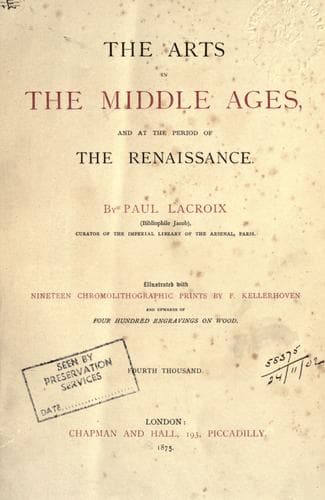
The Arts in the Middle Ages and at the Period of the RenaissanceJacob, P. L.
History
The Arts in the Middle Ages and at the Period of the Renaissance
Jacob, P. L.
Art, Medieval; Art, Renaissance; Middle Ages
sounded the trumpet. When the concert was finished, the bell tolled;
then immediately a cock, perched on the summit, spread his wings
noisily, and made his crowing to be heard. The striking machinery, by
means of movable trap-doors, cylinders, and springs concealed in the
interior of the clock, set in motion a considerable number of automata,
executed with much skill. Angelo Rocca adds that the completion of this
_chef-d’œuvre_ was attributed to Nicolas Copernicus; and that when this
able mechanician had finished his work, the sheriffs and consuls of the
city had his eyes put out in order to render it impossible for him to
execute a similar clock for any other city. This last statement is the
more deserving to rank among mere legends from the fact that,
independent of existing proof of the clock being made by Conrad
Dasypodius, it would be very difficult to prove that Copernicus ever
visited Alsace, or had his eyes put out.
A similar tradition is attached to the history of another clock still in
existence, and which was not less celebrated than that of Strasburg. We
refer to that of the Church of St. John at Lyons, made in 1598 by
Nicholas Lippius, a clockmaker of Basle; repaired and enlarged
subsequently by Nourisson, an artisan of Lyons. Only the horary
mechanism now acts; but the clock is not on that account neglected by
visitors, to whom the worthy attendants still repeat, in perfect faith,
that Lippius was put to death as soon as he had finished his
_chef-d’œuvre_. To show the improbability of this pretended penalty it
is sufficient to remark, with M. Dubois, that even in the sixteenth
century persons were not killed for the crime of making _chefs-d’œuvre_;
and there is, besides, proof that Lippius died in peace, and honoured,
in his native country.
To these famous clocks must be added those of St. Lambert at Liège, of
Nuremberg, of Augsburg, and of Basle; that of Medina del Campo, in
Spain, and those which, in the reign of Charles I., or during the
Protectorship of Cromwell, were manufactured and placed in England, at
St. Dunstan’s in London,[21] and in the Cathedral of Canterbury, in
Edinburgh, and in Glasgow, &c.
Public-domain text, read in full here on John Shaqi.
Reviews
Reviews
No reviews yet
Be the first to share your thoughts on this work.
Elsewhere in the archive
Join the Discussion
Join the discussion
Sign in to leave a comment or review.
Sign InorCreate an account