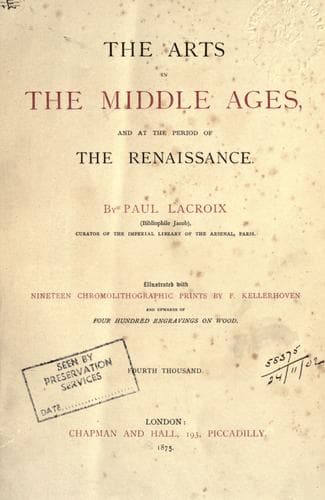
The Arts in the Middle Ages and at the Period of the RenaissanceJacob, P. L.
History
The Arts in the Middle Ages and at the Period of the Renaissance
Jacob, P. L.
Art, Medieval; Art, Renaissance; Middle Ages
Before concluding, and to do justice to a century to which we have
assigned a period of decline, we are bound to acknowledge that some
years before the death of Cardinal Richelieu--that is to say, from 1630
to 1640--artists of ability made praiseworthy efforts to create a new
era in horology. But the improvements they had in view were directed
much more to the processes of the construction of the several parts
composing the clockwork of watches and clocks than to the beauty and
ingenuity of the workmanship. This was progress of a purely professional
character, in order to create a more ready and inexpensive supply; a
progress which we may regard as services rendered by art to trade. The
period of great constructions and delicate marvels was past. Ornamental
_Jacquemarts_ were no longer placed in belfries. Mechanical
_chefs-d’œuvre_ were no longer set in frail gems. The time was still far
off when, laying down the sceptre of that empire on which “the sun never
sets,” the conqueror of Francis I., retiring to a cloister, employed
himself in the construction of the most complicated clockwork. Charles
V. had as assistant, if not as teacher, in his work the learned
mathematician, Jannellus Turianus, whom he had induced to join him in
his retreat. It is said that he enjoyed nothing so much as seeing the
monks of Saint-Just standing amazed before his alarum watches and
automaton clocks; but it is also stated that he manifested the greatest
despair when obliged to admit it was as impossible to establish perfect
concord among clocks as among men.
In truth, Galileo had not yet arrived to observe and formulate the laws
of the pendulum, which Huygens was happily to apply to the movements of
horology.
[Illustration: Fig. 153.--Top of an Hour-Glass, engraved and gilt. (A
French Work of the Sixteenth Century.)]
MUSICAL INSTRUMENTS.
Music in the Middle Ages.--Musical Instruments from the Fourth to
the Thirteenth Century.--Wind Instruments: the Single and Double
Flute, the Pandean Pipes, the Reed-pipe, the Hautboy, the
Flageolet, Trumpets, Horns, _Olifants_, the Hydraulic Organ, the
Bellows-Organ.--Instruments of Percussion: the Bell, the Hand-bell,
Cymbals, the Timbrel, the Triangle, the _Bombulum_,
Drums.--Stringed Instruments: the Lyre, the Cithern, the Harp, the
Psaltery, the _Nable_, the _Chorus_, the _Organistrum_, the Lute
and the Guitar, the _Crout_, the _Rote_, the Viola, the _Gigue_,
the Monochord.
The history of Music in the Middle Ages would commence about the fourth
century of our era. In the sixth century, Isidore of Seville, in his
“Sentiments sur la Musique,” writes as follows:--“Music is a modulation
of the voice, and also an accordance of several sounds and their
simultaneous union.”
Public-domain text, read in full here on John Shaqi.
Reviews
Reviews
No reviews yet
Be the first to share your thoughts on this work.
Elsewhere in the archive
Join the Discussion
Join the discussion
Sign in to leave a comment or review.
Sign InorCreate an account