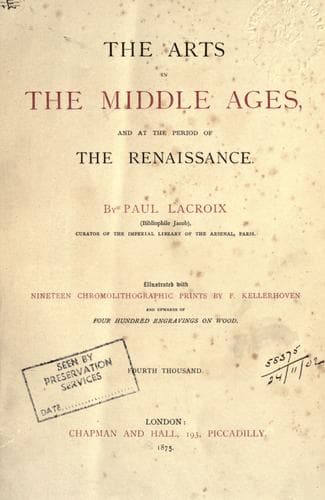
The Arts in the Middle Ages and at the Period of the RenaissanceJacob, P. L.
History
The Arts in the Middle Ages and at the Period of the Renaissance
Jacob, P. L.
Art, Medieval; Art, Renaissance; Middle Ages
Etienne Chevalier, as the most skilful designer of emblems of the
period, was eminently capable of substituting, in playing-cards, ladies
or queens for the Oriental “viziers” or Italian “knights” which, on the
_tarots_, figured alone among the “kings” and “knaves.” We must,
however, repeat that we have no intention of depriving La Hire of the
honour of the invention, and only hazard a supposition in addition to
the opinion generally received.
These cards, which bear all the characteristics of the reign of Charles
VII., must be looked upon as the first attempts at wood-engraving, and
at printing by means of engraved blocks. They were probably executed
between 1420 and 1440, that is to say, prior to most of the known
xylographic productions. Playing-cards, therefore, served as a kind of
introduction or prelude to printing from engraved blocks, an invention
which considerably preceded the printing from movable characters.
When, however, we observe that so early as the middle of the fifteenth
century playing-cards were spread all over Europe, it is but natural to
imagine that some economical plan of manufacture had been discovered and
employed. Thus, as we have already mentioned, Jacquemin Gringonneur, in
1392, was paid fifty-six sols of Paris, that is about £7 1_s._ 8_d._ of
our present money, for three packs of _tarots_, painted for the King of
France. One single pack of _tarots_, admirably painted, about the year
1415, by Marziano, secretary to the Duke of Milan, cost one thousand
five hundred golden crowns (about £625); but in 1454, a pack of cards
intended for the Dauphin of France cost no more than five _sous of
Tours_ (about eleven or twelve shillings). In the interval between 1392
and 1454 means had been discovered of making playing-cards at a cheap
rate, and of converting them into an object of trade; mercers were
accustomed to sell them together with the “pins,” which then took the
place of copper and silver counters; hence the French proverb, “Tirer
son épingle du jeu” (to get out of a scrape).
Public-domain text, read in full here on John Shaqi.
Reviews
Reviews
No reviews yet
Be the first to share your thoughts on this work.
Elsewhere in the archive
Join the Discussion
Join the discussion
Sign in to leave a comment or review.
Sign InorCreate an account