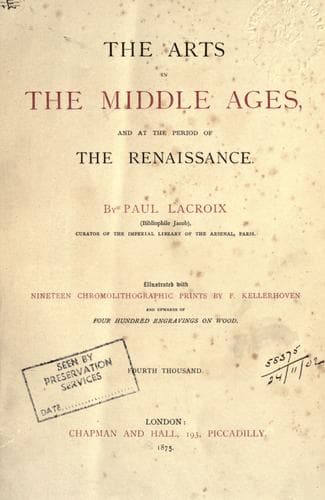
The Arts in the Middle Ages and at the Period of the RenaissanceJacob, P. L.
History
The Arts in the Middle Ages and at the Period of the Renaissance
Jacob, P. L.
Art, Medieval; Art, Renaissance; Middle Ages
The cards that might be styled those of Charles VII., which appear to us
to convey some reminiscence of the _ballet des ardents_, have no
inscription but the name of the cardmaker. But in the other pack of the
same date the “knave of clubs” bears as a legend the word _Rolan_; the
“king of clubs,” _Sans Souci_; the “queen of clubs,” _Tromperie_; the
“king of diamonds,” _Corsube_; the “queen of diamonds,” _En toi te fie_;
the “king of spades,” _Apollin_, &c. This collection of names reveals to
us the threefold influence of the Saracenic origin of playing-cards, the
ideas conveyed at that period to the mind by the reading of the old
romances of chivalry, and the effect of contemporary events. In fact, in
the ancient epics, _Apollin_ (or Apollo) is a deity by whom the Saracens
were accustomed to swear; _Corsube_ is a knight of Cordova (_Corsuba_).
_Sans Souci_ is evidently one of those _sobriquets_ which squires
acquired the habit of adopting at the time they were proving themselves
worthy of the title of knight. Roland, the mighty Paladin who died at
Roncevaux fighting against the Saracens, seems to have been placed upon
the cards in order to oppose the memory of his glory to that of the
infidel kings. The queen “_En toi te fie_” might well allude to Joan of
Arc. The queen “_Tromperie_” recalls to mind Isabel of Bavaria, who was
an unfaithful wife and a cruel mother; and, moreover, had betrayed
France to England. All these ideas are doubtless mere suppositions, but
such as a critical examination of a more minute and extended character
would perhaps succeed in changing into unquestionable certainties.
Next after the cards of the time of Charles VII. follow, as the most
ancient in point of date, two packs which certainly belong to the reign
of Louis XII. One of these packs does not bear any kind of legend; in
the other the “king of hearts” is called _Charles_; the “king of
diamonds,” _Cæsar_; the “king of clubs,” _Arthur_; the “king of spades,”
_David_; the “queen of hearts,” _Héleine_; the “queen of diamonds,”
_Judith_; the “queen of clubs,” _Rachel_; the “queen of spades,”
_Persabée_ (doubtless for Bathsheba).
In a pack of cards belonging to the reign of Francis I., the “king of
clubs” becomes _Alexander_, and the name of _Judith_ is transferred to
the “queen of hearts;” and for the first time (at least in the specimens
which have been preserved) some of the “knaves” bear special names--the
“knave of hearts” is _La Hire_, and the “knave of diamonds” _Hector of
Trois_ (_sic_).
Public-domain text, read in full here on John Shaqi.
Reviews
Reviews
No reviews yet
Be the first to share your thoughts on this work.
Elsewhere in the archive
Join the Discussion
Join the discussion
Sign in to leave a comment or review.
Sign InorCreate an account