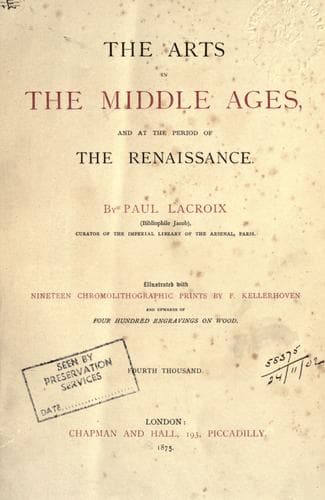
The Arts in the Middle Ages and at the Period of the RenaissanceJacob, P. L.
History
The Arts in the Middle Ages and at the Period of the Renaissance
Jacob, P. L.
Art, Medieval; Art, Renaissance; Middle Ages
[Illustration: Fig. 215.--Card of Italian _Tarots_, from the Pack of the
_minchiate_. (Collection of Playing-Cards, Bibl. Imp., Paris.)]
The Spaniards must certainly have received the Oriental _naïb_ from the
Moors and Saracens a long time prior to the introduction of this game
into Europe at Viterbo; but we have no written proofs which certify to
the existence of cards among the Saracens of Spain. The first document
in which they are mentioned is the edict of John I., of the date of
1387, to which reference has been made. Certain _savants_ have
endeavoured to ascertain the signification of the four suits of the
Spanish _naypes_, and have fancied that they could distinguish in them a
special symbolism. In their view, the _dineros_, _copas_, _bastos_, and
_spadas_, denoted the four estates which composed the population: the
merchants, who have the money; the priests, who hold the chalice or cup;
the peasantry, who handle the staff; and the nobles, who wear the
sword. This explanation, although ingenious, does not appear to us to be
based on any very solid foundation. The signs or suits of the numeral
cards were fixed upon in the East, and Spain as well as Italy merely
adopted them without taking much trouble to penetrate into their
allegorical meaning. The Spaniards became so addicted to this game that
they soon preferred it to any other recreation; and we know that when
the companions of Christopher Columbus, who had just discovered America,
formed their first settlement at St. Domingo, they almost instantly set
to work to make playing-cards out of the leaves of trees.
[Illustration: Figs. 216 and 217.--The “Three” and “Eight” of “Bells.”
German Cards of the Sixteenth Century. (Bibl. Imp. of Paris.
Print-Room.)]
There can be no doubt that playing-cards very soon made their way from
Italy into Germany; but as they advanced towards the North they almost
immediately lost their Oriental characteristics and Saracenic name.
There is, in fact, no longer any etymological trace to be found in the
old German language of the words _naïb_, _naïbi_, or _naypes_. Cards
were called
[Illustration: Figs. 218 and 219.--The “Two of Bells” and the “King of
Acorns,” taken from a Pack of Cards of the Sixteenth Century, designed
and engraved by a German Master. (Bibl. Imp. of Paris. Print-Room.)]
Public-domain text, read in full here on John Shaqi.
Reviews
Reviews
No reviews yet
Be the first to share your thoughts on this work.
Elsewhere in the archive
Join the Discussion
Join the discussion
Sign in to leave a comment or review.
Sign InorCreate an account