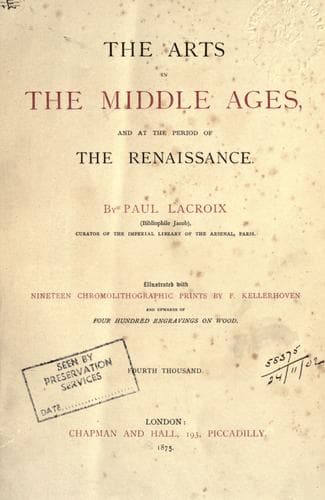
The Arts in the Middle Ages and at the Period of the RenaissanceJacob, P. L.
History
The Arts in the Middle Ages and at the Period of the Renaissance
Jacob, P. L.
Art, Medieval; Art, Renaissance; Middle Ages
In the eighth century, the epoch at which the use of glass-windows was
becoming general, the basilica of St. John Lateran and the Church of St.
Peter at Rome possessed coloured glass-windows; and Charlemagne, who had
caused mosaics of coloured glass to be made in a large number of
churches, did not fail to avail himself of this kind of ornament in the
cathedral erected by him at Aix-la-Chapelle.
Up to this time the only method of making glass was in small pieces,
generally round, and designated by the name of _cires_, a number of
which by means of a network of plaster, wooden frames, or strips of
lead, were used to fill up the windows. This material being, however,
very costly, it could only be introduced into edifices of great
importance. Added to this, it can scarcely be a source of wonder if, at
a time when all branches of art had relapsed into a sort of barbarism,
and glass was only exceptionally employed in ordinary purposes, no one
thought of decorating it with painted figures and ornaments.
With regard to mosaic, either in marble or coloured glass, Martial,
Lucretius, and other writers of antiquity, mention it in their works.
Egypt had a knowledge of it even before Greece; the Romans were
accustomed to employ it in ornamenting the roofs and pavement of their
temples, and even their columns and streets. Some magnificent specimens
of these decorations have remained to our time, and they are considered
as inseparable from the architecture of the emperors.
Some have desired to attribute the custom of employing coloured glass in
mosaics to the rarity of coloured marbles. Would it not be a more
probable hypothesis that the simultaneous use of marble and glass for
this purpose was the result of improvements in the art of making
mosaics? for glass that, by metallic mixtures, may be brought to a
variety of colours, is much more easily adapted to pictorial
combinations than marble, the tints of which are the result of the
caprices of nature. Seneca, alluding to the use of coloured glasses in
mosaic, complains of people not being able “to walk except on precious
stones;” this shows how prevalent the use of rich mosaics had become in
Rome. But this art must have singularly fallen into decay, for the few
examples of the kind we now possess, which date from the first centuries
of Christianity, are marked with a character of simplicity that fully
harmonises with the rudeness of the artists of those times. Among these
specimens must be mentioned a pavement discovered at Rheims, upon which
are represented the twelve signs of the zodiac, the seasons of the year,
and Abraham’s Sacrifice; another on which are depicted Theseus and the
labyrinth of Crete, in juxtaposition with David and Goliath. It is,
moreover, known that there existed in the Forum of Naples a portrait in
mosaic of Theodoric, king of the Goths, who had caused a representation
of the Baptism of Christ to be executed, in the church of Ravenna, by
the same process.
Public-domain text, read in full here on John Shaqi.
Reviews
Reviews
No reviews yet
Be the first to share your thoughts on this work.
Elsewhere in the archive
Join the Discussion
Join the discussion
Sign in to leave a comment or review.
Sign InorCreate an account