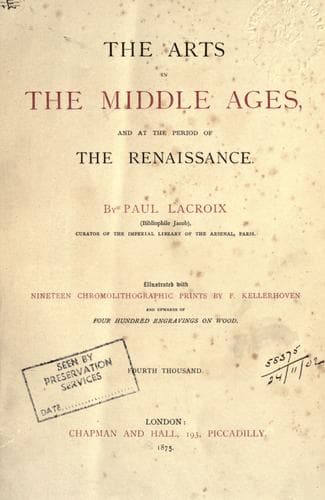
The Arts in the Middle Ages and at the Period of the RenaissanceJacob, P. L.
History
The Arts in the Middle Ages and at the Period of the Renaissance
Jacob, P. L.
Art, Medieval; Art, Renaissance; Middle Ages
Sidonius Apollinaris, describing the excessive luxury
of Consentius at Narbonne, speaks of arches and pavements ornamented
with mosaics. The churches of St. John Lateran, St. Clement, and St.
George in Velabro, at Rome, still display mosaics of this period.
Lastly, Charlemagne caused the greater part of the churches constructed
by him to be ornamented with mosaics.
To return to glass-work, we find that in the time of Charles the Bald,
in 863, mention is made of two artisans, Ragenat and Balderic, who
became as it were the heads of the race of French glass-makers. We also
learn from the chronicle of St. Benignus of Dijon, that in 1052 there
existed in that church a “very ancient painted window,” representing St.
Paschasie, which was said to have been taken from the earlier church. We
have therefore a right to conclude that at this period the custom of
painting on glass had long been common.
In the tenth century glass-makers must have acquired some degree of
importance, for the reigning Dukes of Normandy of that era established
certain privileges in their favour; but, says Champollion-Figeac, “as
all privilege was the prerogative of the order of nobility, they
contrived to give them to noble families whose fortunes were precarious.
Four Norman families obtained this distinction. But although it was
understood that in devoting themselves to the trade these titled
individuals incurred no degradation, it was never said, as is commonly
believed, that the profession of this art conferred nobility; on the
contrary, a proverb arose which long continued in use, namely, that ‘in
order to make a gentleman glass-maker, you must first take a
gentleman.’”
Although painting on glass was from that time carried on with
considerable activity, in many cases it was still very far from being
accomplished by the processes which were destined to make it one of the
most remarkable productions of art. The application of the brush to
vitrifiable colours was not generally adopted. In the examples of this
period that remain to our days, we indeed find large _cives_ cast in
white glass, upon which characters were painted by the artist; but, as
the colour was not designed to be incorporated with the glass by the
action of fire, with a view to ensure the preservation of the painting,
another transparent but thick _cive_ was placed over the first and
closely soldered to it.
While glass-painting was thus seeking to perfect its processes, mosaic
work gradually declined. Only a very small number of mosaics of the
tenth and eleventh centuries exist at the present day, and these,
moreover, are very incorrect in design, and entirely wanting in taste
and colour.
Public-domain text, read in full here on John Shaqi.
Reviews
Reviews
No reviews yet
Be the first to share your thoughts on this work.
Elsewhere in the archive
Join the Discussion
Join the discussion
Sign in to leave a comment or review.
Sign InorCreate an account