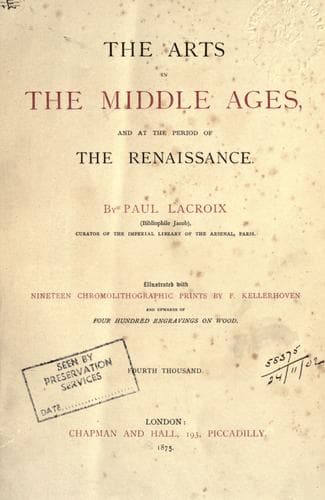
The Arts in the Middle Ages and at the Period of the RenaissanceJacob, P. L.
History
The Arts in the Middle Ages and at the Period of the Renaissance
Jacob, P. L.
Art, Medieval; Art, Renaissance; Middle Ages
In the twelfth century all the arts began to revive. The fear of the end
of the world, which had thrown mankind into a strange state of
perturbation, was dissipated. The Christian faith everywhere stirred up
the zeal of its disciples. Magnificent cathedrals with imposing arches
sprang up in various places, and the art of the glass-maker came to the
aid of architecture in order to diffuse over the interiors consecrated
to worship the light, both prismatic and harmonious, which affords the
calm, necessary for holy meditation. But though, in the painted windows
of this period, we are forced to admire the ingenious combinatian of
colours for the rose-work (rose-windows), the case is very different as
regards the drawing and colouring of the designs. The figures are
generally traced in rough, stiff lines on glass of a dull tint, which
absorbs all the expression of the heads; the entire drapery of the
costume is heavy; the figure is spoilt by the folds of
[Illustration: Fig. 231.--St. Timothy the Martyr, Coloured Glass of the
end of the Eleventh Century, found in the Church of Neuwiller (Bas-Rhin)
by M. Bœswillwald. (From the “History of Glass-Painting,” by M.
Lasteyrie.)]
its vestments as if it were enclosed in a long sheath. This is the
general character of the examples of that period as they are known to us
(Fig. 231).
The painted windows which Suger made to adorn the abbey-church of St.
Denis, some of which exist in our days, date from the twelfth century.
The abbot made inquiries in every country, and gathered together at a
great expense the best artists he could find, in order to assist in this
decoration. The Adoration of the Magi, the Annunciation, the History of
Moses, and various allegories, are there represented in the chapel of
the Virgin and those of St. Osman and St. Hilary. Among the principal
pictures may be also observed a portrait of Suger himself at the feet of
the Virgin. The borders surrounding the subjects may be considered as
models of harmony and good arrangement of effect; but still the taste
shown in the selection and combination of colours is carried to the
highest point in the subjects themselves, the designs of which are very
excellent.
In the Church of St. Maurice, at Angers, we find examples of a rather
earlier date--perhaps the most ancient specimens of painted windows in
France; these are the history of St. Catherine and that of the Virgin,
which, in truth, are not equal in merit, as regards execution and taste,
to the ancient windows of the Church of St. Denis.
Public-domain text, read in full here on John Shaqi.
Reviews
Reviews
No reviews yet
Be the first to share your thoughts on this work.
Elsewhere in the archive
Join the Discussion
Join the discussion
Sign in to leave a comment or review.
Sign InorCreate an account