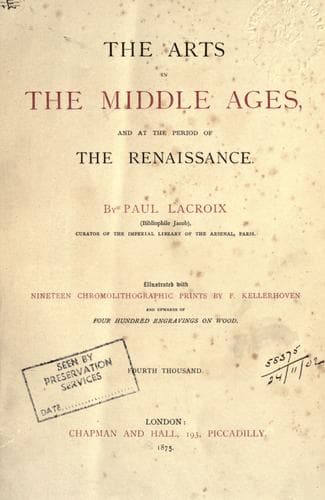
The Arts in the Middle Ages and at the Period of the RenaissanceJacob, P. L.
History
The Arts in the Middle Ages and at the Period of the Renaissance
Jacob, P. L.
Art, Medieval; Art, Renaissance; Middle Ages
“The architecture of the thirteenth century,” according to the judicious
remarks of Champollion-Figeac, “by its style of moulding, which is more
slender and graceful than the massive forms of Roman art, opened a
wider and more favourable field for artists in glass. The small pillars
then projected, and extended themselves with a novel elegance, and the
tapering and delicate spires of the steeples lost themselves in the
clouds. The windows occupied more space, and likewise had the appearance
of springing lightly and gracefully upwards. They were adorned with
symbolical ornaments, griffins, and other fantastic animals; leaves and
boughs cross and intertwine with one another, producing that varied
rose-work which is the admiration of modern glass-makers. The colours
are more skilfully combined and better blended than in the windows of
the preceding century; and although some of the figures are still
wanting in expression, and have not thrown off all the stiffness which
characterised them, the draperies, at least, are lighter and better
drawn.” Examples of the thirteenth century which have remained to our
time are very numerous. There is at Poitiers some painted glass composed
of small roses, and chiefly placed in one of the windows in the centre
of the church and in the “Calvary” of the apse; at Sens, the legend of
St. Thomas of Canterbury is represented in a number of small medallions,
called _verrières légendaires_; at Mans is glass representing the
corporations of trades; at Chartres, the painted glass in the cathedral,
a work both magnificent and extensive, contains no fewer than one
thousand three hundred and fifty subjects, distributed throughout one
hundred and forty-three windows. At Rheims, the painted glass is perhaps
less important, but it is remarkable both for the brilliancy of its
colours and also for its characteristic fitness to the style of the
edifice. Bourges, Tours, Angers, and Notre-Dame in Paris, present very
beautiful specimens. The Cathedral of Rouen possesses, to this day, a
window which bears the name of Clement of Chartres, _master glazier_,
the first artist of this kind who has left behind him any work bearing
his signature. We must, in conclusion, mention the Sainte-Chapelle,
Paris, which is unquestionably the highest representation of what the
art is capable of producing. The designs of the windows in this last
edifice are _legendary_, and although some few inaccuracies may be
noticed in the figures, the fault is redeemed by the studied elegance of
the ornamentation and the harmony of colours, which combine to render
them one of the most consistent and perfect works of painting on glass.
Public-domain text, read in full here on John Shaqi.
Reviews
Reviews
No reviews yet
Be the first to share your thoughts on this work.
Elsewhere in the archive
Join the Discussion
Join the discussion
Sign in to leave a comment or review.
Sign InorCreate an account