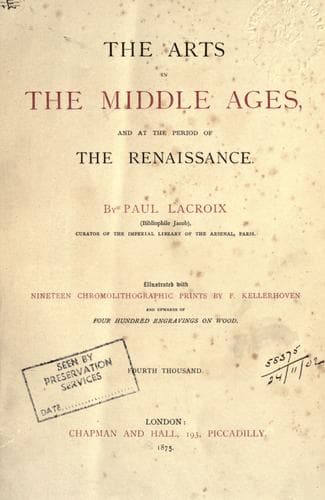
The Arts in the Middle Ages and at the Period of the RenaissanceJacob, P. L.
History
The Arts in the Middle Ages and at the Period of the Renaissance
Jacob, P. L.
Art, Medieval; Art, Renaissance; Middle Ages
In the thirteenth century “_grisaille_” first made its appearance; it
was quite a new style, and has been often since employed in the borders
and ornaments of painted windows. “_Grisaille_,”[30] the name of which
is to some extent sufficient to describe its aspect, was used
simultaneously with the mosaics of variegated glass, as we see in the
Church of St. Thomas, Strasbourg, in the Cathedral of Freybourg in
Brisgau, and in many churches of Bourges.
The large number of paintings on glass belonging to the thirteenth
century, which may still be studied in various churches, has given rise
to the idea of classifying all these monuments, and arranging them under
certain schools, which have been designated by the names of
_Franco-Norman_, _Germanic_, &c. Some have even gone further, and
desired to recognise in the style peculiar to the artists of ancient
France a Norman style, a Poitevin style (the latter recognisable, it is
said, by the want of harmony in the colours), &c. We can hardly admit
these last distinctions, and are the less inclined to do so, as those
who propound them seem to base their theories rather on the defects than
the good qualities of the artists. Besides, at a period in which a
nobleman sometimes possessed several provinces very distant from each
other--as, for example, Anjou and Provence--it might so happen that the
artists he took with him to his different residences could scarcely
fail, by the union of their various works, to cause any provincial
influences to disappear, and would finally reduce the distinction
between what is called the Poitevin style, the Norman style, &c., to a
question of a more or less skilful manufacture, or of a more or less
advanced improvement.
In the fourteenth century the artist in glass became separated from the
architect; although naturally subordinate to the designer of the
edifice, in which the windows were to be only an accessory ornament, he
wished to give effect to his own inspiration. The whole of the building
was subjected by him to the effect of his more learned and correct
drawing, and his purer and more striking colouring. It mattered little
to him should some part of the church have too much light, or not light
enough, if a flood of radiance deluged the apse or the choir, instead of
being gradually diffused everywhere, as in earlier buildings. He desired
his labour to recommend him, and his work to do him honour.
The court-poets, Guillaume de Machaut and Eustache Deschamps, celebrate
in their poems several works in painted glass of their time, and even
give some details in verse on the mode of fabricating them.
[Illustration: Fig. 233.--Legend of the Jew of the Rue des Billettes,
Paris, piercing the Holy Wafer with his Knife. (From a Window of the
Church of St. Alpin, at Châlons-sur-Marne. Fourteenth Century.)]
Public-domain text, read in full here on John Shaqi.
Reviews
Reviews
No reviews yet
Be the first to share your thoughts on this work.
Elsewhere in the archive
Join the Discussion
Join the discussion
Sign in to leave a comment or review.
Sign InorCreate an account