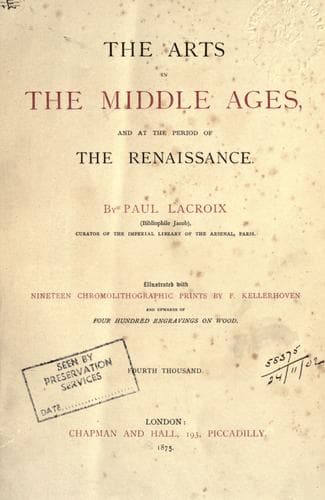
The Arts in the Middle Ages and at the Period of the RenaissanceJacob, P. L.
History
The Arts in the Middle Ages and at the Period of the Renaissance
Jacob, P. L.
Art, Medieval; Art, Renaissance; Middle Ages
was being introduced into France. Albert Dürer employed his pencil in
painting twenty windows in the church of the Old Temple, in Paris, and
produced a collection of pictures characterised by vigorous drawing, and
warm and intense colouring. The celebrated German did not work
alone--other artists assisted him; and, notwithstanding the devastations
which took place during the Revolution, in many a church and mansion
traces of these skilful masters may still be found; their compositions,
which are generally as well arranged as they are executed, are marked
with a tinge of German simplicity very suitable to the pious nature of
the subjects they represent.
In 1600, Nicholas Pinaigrier placed in the windows of the Castle of La
Briffe seven pictures in “_grisaille_,” copied from the designs of
Francis Floris, a Flemish master, who was born in 1520. At this same
period Van Haeck, Herreyn, John Dox, and Pelgrin Rösen, all belonging to
the school of Antwerp, and other artists who had decorated the windows
of most of the churches in Belgium, especially St. Gudule in Brussels,
influenced either directly or indirectly the glass-painters of the east
and north of France. Another group of artists, the Provençals, imitators
of the Italian style, or rather perhaps inspired by the same luminary,
the sun of Michael Angelo, trod a similar path to that which Jean
Cousin, Pinaigrier, and Palissy had followed with so much renown. The
chiefs of this school were Claude, and Guillaume of Marseilles, who, as
we have just mentioned, carried their talent and their works into Italy,
where they succeeded in educating some clever pupils.
With regard to the school of Messin or Lorraine, it is principally
represented by a disciple of Michael Angelo, Valentin Bousch, the
Alsatian, who died in 1541 at Metz, where he had executed, since 1521,
an immense number of works. The windows of the churches of St. Barbe,
St. Nicolas du Port, Autrey, and Flavigny-sur-Moselle, are due to the
same school, in which Israel Henriet was also brought up; he became the
chief of a school exclusively belonging to Lorraine, at the time when
Charles III. had invited the arts to unite under the patronage of the
ducal throne. Thierry Alix, in a “Description inédite de la Lorraine,”
written in 1590, and mentioned by M. Bégin, speaks of “large plates of
glass of all colours,” made in his time in the mountains of Vosges,
where “all the herbs and other things necessary to painting” were found.
M. Bégin, after having quoted this curious statement, adds that the
windows which at that era were produced in the studios of Vosges, and
subsequently carried to all parts of Europe, constituted a very active
branch of commerce.
“Nevertheless,” says Champollion-Figeac, “art was declining. Christian
art especially was disappearing, and had almost come to an end, when
Protestantism stepped in and gave it the last blow; this is proved by
the window in the cathedral church of Berne, in which the artist,
Frederic
Public-domain text, read in full here on John Shaqi.
Reviews
Reviews
No reviews yet
Be the first to share your thoughts on this work.
Elsewhere in the archive
Join the Discussion
Join the discussion
Sign in to leave a comment or review.
Sign InorCreate an account