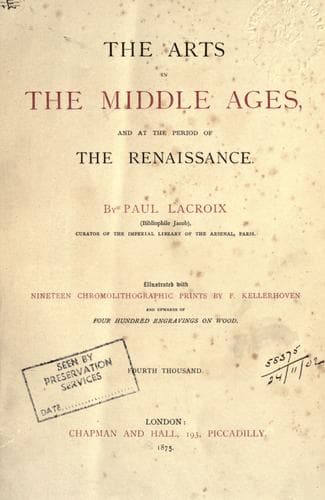
The Arts in the Middle Ages and at the Period of the RenaissanceJacob, P. L.
History
The Arts in the Middle Ages and at the Period of the Renaissance
Jacob, P. L.
Art, Medieval; Art, Renaissance; Middle Ages
“Too frequently in conversational language and even in the writings of
grave authors,” says M. Ernest Breton, “the word _fresco_ is made
synonymous with mural painting in general. This confusion of terms has
sometimes caused the most fatal errors. The etymology of the word is the
best definition of the subject. The Italians give the name of paintings
_in fresco_ or _a fresco_, that is to say, _à frais_, or _sur le frais_,
to those works executed upon damp stucco into which the colour
penetrates to a certain depth. The ancient French authors, preserving
the difference existing between the Italian _fresco_ and the French
_frais_, wrote the word _fraisque_. At the present day Italian
orthography has prevailed, and with us this word has now more relation
to its etymology than its real signification.”
Whatever may be the common acceptation of the word, we must, in order to
keep within the limits of our subject, here only take into consideration
real frescoes, or in other words, works of art executed upon a bare
wall, properly prepared for the purpose, with which they are as it were
incorporated; for in the roll of art all are excluded from the catalogue
of mural paintings, rightly so called, which, although applied to walls
either directly or by the aid of panels or fixed canvas, are produced
otherwise than with water-colours, and used in such a manner as to
penetrate the special kind of plaster with which the wall had been
previously covered. We will mention as a striking example of this the
famous “Lord’s Supper” of Leonardo da Vinci, which has many times been
called a fresco (it is well known to have been painted upon the wall of
the refectory of Santa Maria della Gratia, at Milan), but is nothing but
a painting in distemper[32] on a dry partition--a circumstance,
by-the-bye, which has not a little contributed to the deterioration of
this magnificent work.
Fresco has long been considered the most ancient style of painting.
Vasari, who wrote in the middle of the sixteenth century, says in apt
terms that “the ancients generally practised painting _in fresco_, and
the first painters of the modern schools have only followed the antique
methods;” and, in our own day, Millin, in his “Dictionnaire des
Beaux-Arts,” asserts that the great paintings in the “Pœcile” of Athens
and the “Lesche” of Delphi, by Panænus and Polygnotus, spoken of by
Pausanias, were executed by this process; the same author also ranks
among frescoes the numerous paintings left by the Egyptians in their
temples and catacombs. “It was,” he remarks, “what the Romans called _in
udo pariete pingere_ (to paint on a damp wall); they say _in cretula
pingere_ (to paint on chalk) to designate water-colour painting on a dry
ground.”
Public-domain text, read in full here on John Shaqi.
Reviews
Reviews
No reviews yet
Be the first to share your thoughts on this work.
Elsewhere in the archive
Join the Discussion
Join the discussion
Sign in to leave a comment or review.
Sign InorCreate an account