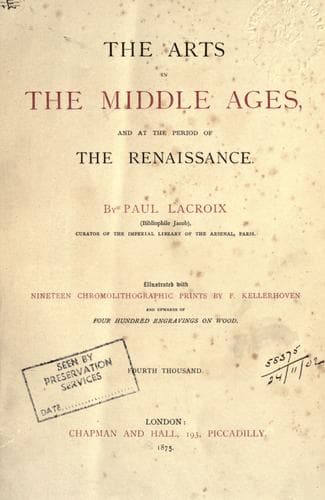
The Arts in the Middle Ages and at the Period of the RenaissanceJacob, P. L.
History
The Arts in the Middle Ages and at the Period of the Renaissance
Jacob, P. L.
Art, Medieval; Art, Renaissance; Middle Ages
Next we have Raphael, _il divino Sanzio_, as he was called by his
numerous admirers, whose genius was constantly attaining to grandeur by
means of simplicity, and to power by means of reserve. Michael Angelo
always seems as if he were only able to represent a limited portion of
his gigantic conceptions on the wall he covered with his designs; but it
was sufficient for Raphael to place some tranquil figure on a narrow
square of canvas, and we have before us the bright image of the most
perfect and delicious inspiration. He created for himself a heaven which
he peopled with the purest and most venerated types of the human race;
and a light, as from on high, beams with regal splendour on these
graceful visions. In Raphael, even more than in Leonardo da Vinci, it
seemed as if two artists of equal sublimity succeeded one another. At
first we have the charming dreamer who, in the fresh enthusiasm of his
early youth, creates Madonnas, artless daughters of the earth in whose
look and countenance a sacred light shines in all its ineffable purity;
next he is the master full of the deepest science, for whom the real
beauties of creation have no concealment; who, in representing nature,
succeeded in transforming to her the magnificent ideal of which his own
soul appears to have received the impression from association with the
divine regions.
“The principal characteristic of Raphael,” still following the very just
remarks of M. Michiels, “is the universality of his fame. It becomes
almost painful to hear the vulgar crowd constantly repeating a magic
name, the true signification of which they do not understand.” As the
spoiled child of fortune, the creator of Virgins and “The
Transfiguration,” he is almost without detractors from his fame; and it
is impossible to reckon the number of his admirers. “One circumstance in
his life affords us an emblem of his destiny. Having sent to Palermo the
famous canvas of the ‘Spasimo,’[36] a tempest overwhelmed the ship which
carried it; but the waves seemed to respect the _chef-d’œuvre_. After
having drifted more than fifty leagues through the sea, the box which
enclosed the precious production floated gently on shore at the port of
Genoa. The picture was in no way injured. The Sicilian monks, for whom
it was intended, did not fail to claim it; and since that time, thanks
to the mercy of the waves, it attracts to the foot of Etna numerous
pilgrims to the shrine of genius.”
At Venice, we first have Titian, the painter of Charles V. and Francis
I. “The genius of Titian,” says Alexander Lenoir, “is always great and
noble. No painter has ever produced flesh-colours so beautiful and
life-like. In Titian there is no apparent tone; the colouring of his
flesh is so well blended, that it seems as difficult to imitate as the
model itself. Add to his pictures their truth and expression of action,
and the elegance and richness of the drapery, and we shall have some
idea of the great works which he left behind him.”
Public-domain text, read in full here on John Shaqi.
Reviews
Reviews
No reviews yet
Be the first to share your thoughts on this work.
Elsewhere in the archive
Join the Discussion
Join the discussion
Sign in to leave a comment or review.
Sign InorCreate an account