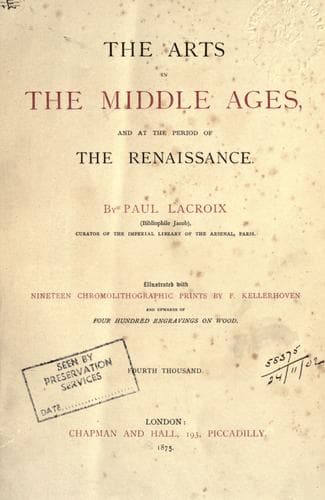
The Arts in the Middle Ages and at the Period of the RenaissanceJacob, P. L.
History
The Arts in the Middle Ages and at the Period of the Renaissance
Jacob, P. L.
Art, Medieval; Art, Renaissance; Middle Ages
Next Jacques Robusti presents himself, who, from the profession of his
father was surnamed Tintoretto (the Dyer). He was at first a pupil of
Titian, who, it is said, from motives of jealousy, dismissed him from
his studio; but the fervour of uninterrupted labour was all that
Tintoretto required in order to mature the most productive talent. “The
drawing of Michael Angelo, and the colouring of Titian”--such was the
ambitious motto he wrote over the door of his humble _atelier_, and we
are almost justified in stating that he was enabled, by force of study
and labour, to fulfil his aspirations, if we look only at some of his
pieces executed before a certain fever of exuberant production had
seized upon and necessarily weakened his vigorous talents. To form some
estimate of the extent to which Tintoretto was impelled by this impulse
of creation, we may recollect that even Paul Veronese reproached him
with being unable to restrain himself--Veronese, the most indefatigable
of producers!
With regard to the latter, his works are characterised not only by the
number of figures in them, but also by the striking brilliancy of the
_mise en scène_. Although he multiplies his actors, they are grouped in
perfect order; although he paints a multitude, he knows how to avoid a
crowd. Notice how a feeling of life profusely pervades the whole of his
vast pictures of important events; an idea of space is everywhere given;
everywhere light plays a powerful part, and imagination has full scope.
He is the painter _par excellence_ of feasts and ceremonies: at once
pompous and natural, his copiousness is only equalled by his dazzling
facility; and we are compelled to forgive the errors with which he
mingles on the same canvas the religious ideas of sacred subjects and
the profane splendour of modern times.
What shall we say about Correggio? There is no methodical scale by which
to measure grace; and there is no formula laid down of delicious
softness. But if, at the Louvre, we examine his “Antiope asleep,” we
shall not soon forget the fascinating power of the old Allegri
(Correggio).
Public-domain text, read in full here on John Shaqi.
Reviews
Reviews
No reviews yet
Be the first to share your thoughts on this work.
Elsewhere in the archive
Join the Discussion
Join the discussion
Sign in to leave a comment or review.
Sign InorCreate an account