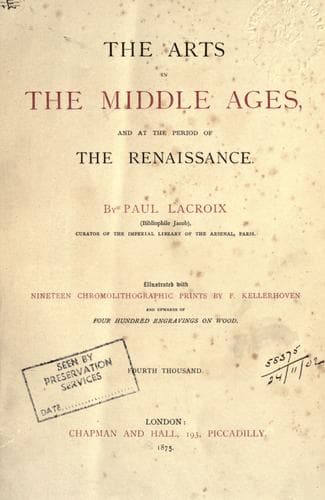
The Arts in the Middle Ages and at the Period of the RenaissanceJacob, P. L.
History
The Arts in the Middle Ages and at the Period of the Renaissance
Jacob, P. L.
Art, Medieval; Art, Renaissance; Middle Ages
Simplicity of Furniture among the Gauls and Franks.--Introduction
of costly taste in articles of Furniture of the Seventh
Century.--Arm-chair of Dagobert.--Round Table of King
Artus.--Influence of the Crusades.--Regal Banquet in the time of
Charles V.--Benches.--Sideboards.--Dinner
Services.--Goblets.--Brassware.--Casks.--Lighting.--Beds.--Carved
Wood Furniture.--Locksmith’s Work.--Glass and Mirrors.--Room of a
Feudal Seigneur.--Costliness of Furniture used for Ecclesiastical
Purposes.--Altars.--Censers.--Shrines and Reliquaries.--Gratings
and Iron-mountings.
We shall be readily believed when we assert that the furniture used by
our remote ancestors, the Gauls, was of the most rude simplicity. A
people essentially addicted to war and hunting,--at the best,
agriculturists,--having for their temples the forests, for their
dwellings huts formed out of turf and thatched with straw and branches,
would naturally be indifferent to the form and description of their
furniture.
Then succeeded the Roman Conquest. Originally, and long subsequent to
the formation of their warlike republic, the Romans had also lived in
contempt of display, and even in ignorance of the conveniences of life.
But when they had subjugated Gaul, and had carried their victorious arms
to the confines of the world, they by degrees appropriated whatever the
manners and habits of the conquered nations disclosed to them of refined
luxury, material progress, and ingenious devices for comfort. Thus, the
Romans brought with them into Gaul what they elsewhere had acquired.
Again, when, in their turn, the semi-barbarous hordes of Germany and of
the Northern steppes invaded the Roman empire, these new conquerors did
not fail to accommodate themselves instinctively to the social condition
of the vanquished.
This, briefly stated, is an explanation--we admit, rather concise--of
the transition connecting the characteristics of the society of olden
days with those of modern society.
Society in the Middle Ages--that social epoch which may be compared to
the state of a decrepid and worn-out old man, who, after a long, dull
torpor awakes to new life, like an active and vigorous child--society in
the Middle Ages inherited much from preceding times, though, to a
certain extent, they were disconnected. It transformed, perhaps; and it
perfected, rather than invented; but it displayed in its works a genius
so peculiar that we generally recognise in it a real creation.
Proposing rapidly to pursue our archæological and literary course
through a twofold period of birth and revival, we cannot indulge the
belief that we shall succeed in exhibiting our sketches in a light the
best adapted to their effect. However, we will make the attempt, and,
the frame being given, will do our best to fill in the picture.
Public-domain text, read in full here on John Shaqi.
Reviews
Reviews
No reviews yet
Be the first to share your thoughts on this work.
Join the Discussion
Join the discussion
Sign in to leave a comment or review.
Sign InorCreate an account