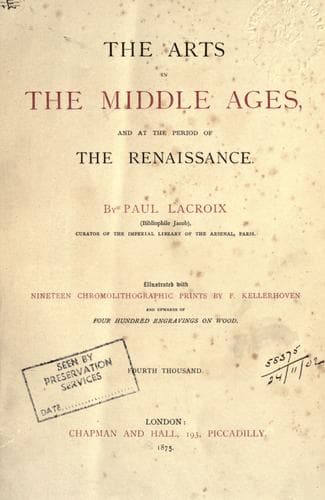
The Arts in the Middle Ages and at the Period of the RenaissanceJacob, P. L.
History
The Arts in the Middle Ages and at the Period of the Renaissance
Jacob, P. L.
Art, Medieval; Art, Renaissance; Middle Ages
The _ring_ St. Agnes is presenting to St. Catherine denotes the bond
which unites the two virgin-martyrs, and attests that both are worthy to
be spouses of Jesus Christ.]
[Illustration: ST. CATHERINE AND ST. AGNES.
Painting attributed to Margaret Van Eyck. (M. Quedeville’s
Collection.)]
the features of his _fiancée_, the Princess Elizabeth (1428). The
influence exercised by his labours is thought to have brought about that
tendency to brilliancy and realism which, after its first manifestation
in the earliest Spanish manner, gave way before the encroachments of
Italian genius, only to reappear in all its power in the great national
school.
Among the best pupils that Van Eyck left behind him at Bruges, we must
not omit the name of Hugo van der Goes, whose works are rare.
Roger van der Weyden, of whose paintings but few are now extant, was the
favourite pupil of John of Bruges, and the master of Hemling, whose
reputation was destined to equal, if not to surpass, that of the chief
of his school. “Hemling,” says M. Michiels, so eminent a judge on this
subject, “whose most ancient picture bears the date 1450, possesses more
sweetness and grace than the Van Eycks. His figures charm by an ideal
elegance; his expression never exceeds the limits of tranquil feeling
and agreeable emotion. Quite contrary to John van Eyck, he prefers the
slender and rich character of the Gothic (Fig. 252) to the heaviness and
scanty detail of Roman architecture. His colouring, although less
vigorous, is softer; the water, the woods, the sites, the grass, and the
distances of his pictures cause a dream-like feeling.”
A kind of instinctive reaction was manifested in the pupil, but the
master was not altogether forgotten. We shall, however, find elsewhere
the effects of his direct influence; but in order not to have to return
to the school of Bruges, we will first mention Jerome Bosch, who,
contrary to his countryman Hemling, sought after opposition of effects
and singularities of invention; and next Erasmus, the great thinker and
writer, who was also a painter in his day;[37] lastly, Cornelius
Engelbrechtsen, the master of Lucas van Leyden, born in 1494. The latter
was as famous with the pencil as with the graving tool, and introduced
into all his works a powerful and sometimes strange originality which
caused him to be looked upon as the first painter of “_genre_.” Lucas
van Leyden must close our list of the artists who opened out the paths
which were destined to be followed, though with many a diversity of
method and of style, by Breughel, Teniers, Van Ostade, Porbus, and
Schellincks. At the head of these masters was subsequently to rise the
magnificent Rubens, and the energetic Rembrandt, the king of the
palette, the great chief of the school, who
[Illustration: Fig 252.--“St. Ursula.” By Hemling.]
Public-domain text, read in full here on John Shaqi.
Reviews
Reviews
No reviews yet
Be the first to share your thoughts on this work.
Elsewhere in the archive
Join the Discussion
Join the discussion
Sign in to leave a comment or review.
Sign InorCreate an account