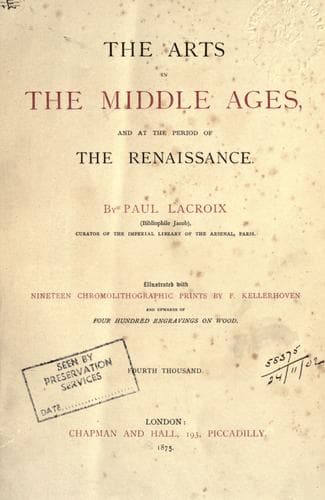
The Arts in the Middle Ages and at the Period of the RenaissanceJacob, P. L.
History
The Arts in the Middle Ages and at the Period of the Renaissance
Jacob, P. L.
Art, Medieval; Art, Renaissance; Middle Ages
John, the younger of the two brothers, was the one to whom renown more
particularly attached (Fig. 251). He is reputed to have been the
inventor of oil-painting; but all he did was to improve the methods
employed. Nevertheless, tradition tells us that an Italian master,
Antonello of Messina, made a journey to Flanders, with the object of
finding out the secret of John Bruges (by which name Van Eyck is often
called); and that he subsequently circulated it throughout the Italian
schools. Be this as it may, John of Bruges, apart from any similarity in
manner (for it was by the force of his colouring, as much as by his new
theories of composition, that he succeeded in revolutionising the old
school of painting), may be considered as the Giotto of the North; but
we must add that the effects of his attempts were much more rapidly
decisive. At one leap, so to speak, the somewhat cold painting of the
Gothic school decked itself with a splendour which left but little for
the future Venetian school to achieve beyond it; with one flight of
genius, stiff and methodical conceptions became imbued with suppleness
and vital action. Finally, we have the first notable sign of the true
feeling of an art combining science and grace--a knowledge of anatomy
is shown in the life-like flesh and under the brilliant draperies. There
is, however, a considerable distance, which cannot fail to be remarked,
separating the two reformers of art whose names we have just brought
together. One, Giotto, desired to grasp the real in order to make it
conduce to the triumph of the ideal; while Van Eyck only accepted the
ideal because he had as yet been unable to apprehend the deepest secrets
of the real. All the other masters are but as the fruit yielded by the
school of the great Florentine, and by those which the descendants of
the Flemish masters were destined to produce. At Ghent, we still have as
an object of admiration, an altar-piece, a _chef-d’œuvre_ of Van Eyck;
it is an immense composition, some portions of which have been removed;
but at first it did not contain less than three hundred figures,
representing the “Adoration of the Paschal Lamb by the Virgins of the
Apocalypse.”
[Illustration: Fig. 251.--“The Holy Virgin, St. George, and St. Donat.”
By John van Eyck. (Museum at Antwerp.)]
John van Eyck resided for some time at the court of Portugal, whither he
had been sent by Philip the Good, Duke of Burgundy, to delineate
[Illustration: “ST. CATHERINE AND ST. AGNES.”
A PICTURE ATTRIBUTED TO MARGARET VAN EYCK.
On the left of the picture is seen St. Catherine of Alexandria holding
in her hands the instruments of her punishment--the _wheel_, which is
broken into fragments, and the _sword_ which decapitated her; below her
is the head of the Emperor Maxmilian II., who ordered her martyrdom.
On the right is St. Agnes, and a _lamb_, the emblem of her innocence and
gentleness.
Public-domain text, read in full here on John Shaqi.
Reviews
Reviews
No reviews yet
Be the first to share your thoughts on this work.
Elsewhere in the archive
Join the Discussion
Join the discussion
Sign in to leave a comment or review.
Sign InorCreate an account