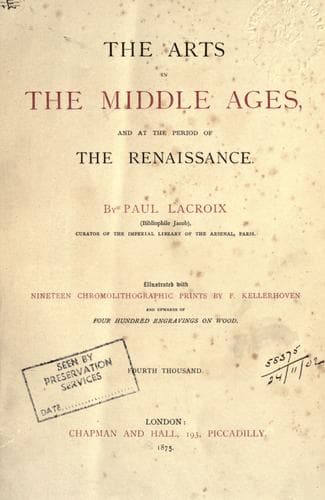
The Arts in the Middle Ages and at the Period of the RenaissanceJacob, P. L.
History
The Arts in the Middle Ages and at the Period of the Renaissance
Jacob, P. L.
Art, Medieval; Art, Renaissance; Middle Ages
to represent with no less success pleasant legends or the most charming
realities. He is the painter of artless youths, aerially veiled, and of
sportive and enchanting virgins; and if some antique scene is created by
his delicate and original pencil, it seem, to be metamorphosed by a
happy facility into something that appears to have the character of a
German reminiscence (Fig. 254).
[Illustration: Fig. 254.--“Princess Sibylla of Saxony,” by Lucas van
Cranach. (Suermondt Collection.)]
Between these two masters, so equally endowed with power in their
respective lines of art, the great Holbein takes his place, as if
embodying the rather abrupt vigour of the one, and the sentimental
delicacy of the other. This painter’s artistic career was carried out
almost entirely in England, but the character of his genius belongs
unquestionably to the country where he left behind him his “Dance of
Death,” a piece of tragic raillery justly held to be the most wonderful
among all the creations of fancy.
Albert Dürer, who died in 1528, and Lucas van Cranach, and Holbein, who
died in 1553,[38] were destined to create a race of painters, and a host
of successors were soon at work. But the movement, which was impeded by
troubles of a religious character, died away in the terrible convulsions
of the Thirty Years’ War, and was never again renewed.
The era in which German art seemed all at once to decline was that
wherein the Italian school flourished in full splendour, and exercised
an unrivalled influence over every European country occupied by the
Latin races. France yielded all the more readily to this foreign
influence, because the Papal court at Avignon had already given an
asylum to Giotto in the first place, and afterwards to Simon Memmi; both
of whom, and especially the last, have left master-like traces of their
presence on French soil.
As a matter of fact, although French painting, regarded in the light of
a national art, cannot boast of having spontaneously produced, as a
thing of home-growth, any of those essays of complete independence of
which Germany and Italy are so proud; the memorials of French art at
least bear witness that, during the long reign of Byzantine tradition,
it never ceased to struggle with some force under the yoke; at a time,
indeed, when Italy and Germany themselves seemed, on the contrary, to
bear the burden with the most submissive servitude.
Public-domain text, read in full here on John Shaqi.
Reviews
Reviews
No reviews yet
Be the first to share your thoughts on this work.
Elsewhere in the archive
Join the Discussion
Join the discussion
Sign in to leave a comment or review.
Sign InorCreate an account