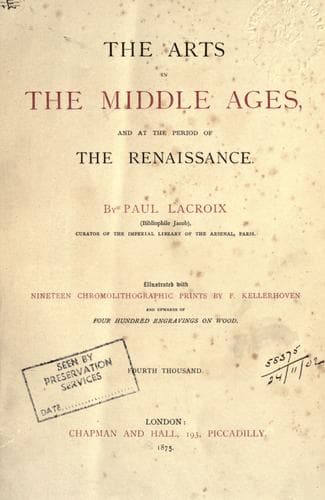
The Arts in the Middle Ages and at the Period of the RenaissanceJacob, P. L.
History
The Arts in the Middle Ages and at the Period of the Renaissance
Jacob, P. L.
Art, Medieval; Art, Renaissance; Middle Ages
The tenth century, in becoming subject to the influence of a foolish but
heartfelt terror (the fear of the end of the world), marked a period of
fatal obstruction to every kind of effort, and progress died away; but
if we look beyond this we shall perceive that, from the earliest days of
the monarchy, painting was held in honour, and painters themselves
afforded proofs of power, if not of genius. We shall, for instance, find
that the basilica of St. Germain-des-Prés, built by Childebert I., had
its walls decorated with “elegant paintings.” We shall find Gondebaud,
the son of Clotaire, himself handling the pencil and “painting the
walls and roofs of oratories.” In the reign of Charlemagne, we discover
the texts which the bishops and priests were compelled to paint on “the
whole interior surface” of their churches, in order that the charm of
the colouring and of the compositions might aid the fervour of faith in
the congregations. But all this is but evidence recorded in the pages of
the ancient chronicles. We have other testimony derived from works still
existing, on which a judgment may be practically passed. Some frescoes
discovered at St. Savin, in the department of Vienne, and at
Nohant-Vicq, in the department of Indre, which must be attributed to the
eleventh and twelfth centuries, attest, in all their rude simplicity,
the efforts of a thoughtful art, and specially bear the stamp of a true
spirit of independence.
The Sainte-Chapelle, in Paris, by its painted windows and the mural
paintings of its crypt, asserts the real vitality of an artistic
feeling, which only waited for the signal of a bolder spirit to rise to
loftier things. Moreover, if other examples are wanting, there are
manuscripts, on the ornamentation of which the most skilful painters
have concentrated their powers, that would suffice to point out the
tendencies and artistic standard of every succeeding age. (See the
article on MINIATURE-PAINTING.) However little we may consult history,
we scarcely ever fail to discover traces of certain groups of artists
whose names or works have survived. Thus, a series of paintings
preserved in the Cathedral of Amiens, as well as the “Sacre de Louis
XII.” and the “Vierge au Froment,” in the museum at Cluny, prove to us
the existence, at the end of the fifteenth century, of the school of
Picardy, which possessed skill in composition, combined with a feeling
for colour and a certain knowledge of handling. Thus, too, the
researches of the learned have traced out the laborious career of the
Clouet family, sung by Ronsard and others, but whose works are almost
entirely lost; thus, also, we find the names of Bourdichon, Perréal,
Foucquet, who worked for Louis XI. and Charles VIII., and that of the
peaceful King René of Provence, who thought it not beneath his dignity
to make himself the practical chief of a school whose nameless
productions are still scattered over the south of France.
Public-domain text, read in full here on John Shaqi.
Reviews
Reviews
No reviews yet
Be the first to share your thoughts on this work.
Elsewhere in the archive
Join the Discussion
Join the discussion
Sign in to leave a comment or review.
Sign InorCreate an account