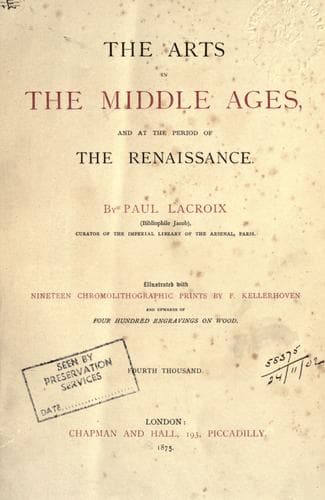
The Arts in the Middle Ages and at the Period of the RenaissanceJacob, P. L.
History
The Arts in the Middle Ages and at the Period of the Renaissance
Jacob, P. L.
Art, Medieval; Art, Renaissance; Middle Ages
With the sixteenth century commenced the age of the great Italian
painters. In 1515, Francis I. persuaded Leonardo da Vinci to come to
France, and to afford the example of his wonderful genius. But the
illustrious creator of “La Gioconda” (the famous portrait of Mona
Lisa), burthened with years and worn out with work, visited France as if
only to draw his last breath (1519). Andrea del Sarto, the graceful
pupil of the severe Michael Angelo, came to France in 1517; but, after
having painted for his royal protector a few pictures, among which was
the magnificent “Charity” in the Louvre, he again repaired to the
Italian soil, to which his unhappy marriage recalled him to his doom.
In 1520 Raphael died, at the age of only thirty-seven years. Giulio
Pippi (called _Giulio Romano_), Francis Penni (called _il Fattore_), and
Perino del Vaga, whom he named as his heirs and charged with the
completion of his unfinished works, did their best to replace the
illustrious dead. For a short time it might have been thought that the
inspiration of the master still remained with his pupils; but soon a
separation of this group of artists, who had found their principal power
in unity of thought, took place; and, fifteen or twenty years after the
tomb had closed on Raphael, the tradition of his school was nothing more
than a glorious ruin.
Michael Angelo, who died in 1563, was destined to have a longer career;
but it was only to become a witness of the rapid decadence of the great
movement he had helped to call forth. After Daniele di Volterra, the
painter of the “Descent from the Cross,” which is classed among the
three most beautiful works that Rome possesses; after Vasari, who
possessed a double title to celebrity as a skilful painter and the
historian of the Italian schools; after Rosso, whose renown subsequently
suffered at the court of France; and Bronzino, who sought success in
taste and delicacy; the school of the great Buonarotti produced nothing
but works which seemed to wander from exaggeration to bad taste. The
dwarfs who attempted to walk in the footsteps of the giant were soon
exhausted, and only succeeded in rendering themselves ridiculous.
The Venetian school, the great masters of which did not become extinct
before the end of the sixteenth century, had its period of decadence at
a later epoch; this will not come under our consideration. The Lombard
school, which, by the deaths of Correggio and Parmigianino, had been
left without its chiefs before the middle of this century (1534 and
1540), seemed for a moment as if it would disappear as it had risen. But
in Michael Angelo Caravaggio (Fig. 255) it met with a powerful master,
who was able for some time to arrest the progress of its decadence.
[Illustration: Fig. 255.--“The Tribute Money.” Picture by Caravaggio
(Sixteenth Century), in the Florence Gallery.]
Public-domain text, read in full here on John Shaqi.
Reviews
Reviews
No reviews yet
Be the first to share your thoughts on this work.
Elsewhere in the archive
Join the Discussion
Join the discussion
Sign in to leave a comment or review.
Sign InorCreate an account