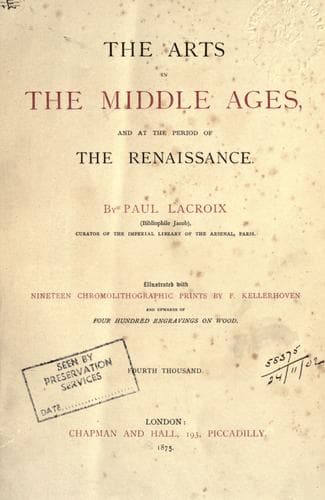
The Arts in the Middle Ages and at the Period of the RenaissanceJacob, P. L.
History
The Arts in the Middle Ages and at the Period of the Renaissance
Jacob, P. L.
Art, Medieval; Art, Renaissance; Middle Ages
Jean Cousin is generally looked upon as the real chief of the French
school. After him, and by his side, we must place the Janets,[39] who
although of Flemish origin, are actually French in their style and the
character of their pictures. The most celebrated of them, François
Clouet, portrayed, with a realism full of elegance and distinction, the
nobles and beautiful ladies of the court of Valois.
[Illustration: Fig. 257.--Sketch of the Virgin of Alba. Chalk-drawing by
Raphael.]
We should here close our remarks, were it not that we might be accused
of an important omission in this review of the principal schools. For
nothing has been said of the Bolognese school, whose origin, though not
its maturity, belongs to the epoch we have made our study. But the
material circumstances we now mention must be our justification:
although the school of Bologna gave signs of its existence in the
thirteenth century, and under the impulse of Guido, Ventura, and Ursone,
showed itself to be industrious, active, and numerous; and also in the
fourteenth century, under that of Jacopo d’Avanzo and Lippodi Dalmasio;
yet it died away, reviving only at the commencement of the sixteenth
century, again to become extinct after the death of the poetic
Raibolini, called _Francia_, without having produced any of those great
individualities to whose glory alone we are compelled to devote our
attention.
We must, however, confess that this school, which suddenly retrieved its
position at a time when all other schools were in a state of complete
decadence, found three illustrious chiefs instead of one, and acquired
the singular glory of resuscitating, by a kind of potent eclecticism,
the _ensemble_ of the noblest traditions. But it was not till the latter
part of the sixteenth century that Bologna witnessed the opening by the
Carracci of that studio whence were destined to proceed Guido, Albano,
Domenichino, Guercino, Caravaggio, Pietro of Cortona and Luca
Giordano--a magnificent phalanx of men who, by their own works and the
force of their example, were to become the honour of an age into which
it does not form a portion of our task to follow them.
[Illustration]
ENGRAVING.
Origin of Wood-Engraving.--The St. Christopher of 1423.--“The
Virgin and Child Jesus.”--The earliest Masters of
Wood-Engraving.--Bernard Milnet.--Engraving in _Camaïeu_.--Origin
of Engraving on Metal.--The “Pax” of Maso Finiguerra.--The earliest
Engravers on Metal.--Niello Work.--_Le Maître_ of 1466.--_Le
Maître_ of 1486.--Martin Schöngauer, Israel van Mecken, Wenceslaus
of Olmutz, Albert Dürer, Marc Antonio, Lucas van Leyden.--Jean
Duret and the French School.--The Dutch School.--The Masters of
Engraving.
Public-domain text, read in full here on John Shaqi.
Reviews
Reviews
No reviews yet
Be the first to share your thoughts on this work.
Elsewhere in the archive
Join the Discussion
Join the discussion
Sign in to leave a comment or review.
Sign InorCreate an account