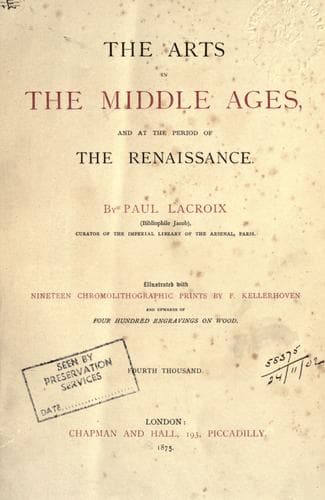
The Arts in the Middle Ages and at the Period of the RenaissanceJacob, P. L.
History
The Arts in the Middle Ages and at the Period of the Renaissance
Jacob, P. L.
Art, Medieval; Art, Renaissance; Middle Ages
Almost all authors who have devoted themselves to investigate this
subject have asserted, but doubtless very erroneously, that engraving on
metal was naturally derived from engraving on wood. Nevertheless, any
one who gives but a slight consideration to the difference existing
between the two processes must be led to the belief that the two arts
must result from two distinct inventions. In wood-engraving, the
impression is, in fact, formed by the portions of the block which are in
relief; while in engraving on metal, the incised strokes give the lines
of the print. Now, no one who has any knowledge of professional matters
can for a moment doubt that, in spite of the similar appearance of the
productions, there is a radical difference in the starting-points and
modes of execution of these two methods.
We certainly must consider it probable that the appearance of prints
produced by wood-engraving may have suggested the idea of seeking to
obtain a similar or better result by some other process; but that a
process should be assimilated, as if by affiliation, to another
diametrically opposed to it is a view we do not feel called upon to
accept without reservation.
Be this as it may, certain authors look upon wood-engraving as having
been invented in Germany at the commencement of the fifteenth century.
Others have derived it from China, where it was in use in the year 1000
of our era. Others, again, propound the opinion that the art of printing
stuffs by means of engraved blocks was employed in different parts of
Asia, to which it had been imported from ancient Egypt, at a period long
before it was first thought of in Europe. These hypotheses being
admitted, the whole question reduces itself into an inquiry as to the
way in which the art made its entrance into Western Europe in the first
half of the fifteenth century; this being the earliest date at which we
find engravings made in Germany, France, and the Low Countries.
[Illustration: Fig. 258.--“The Virgin and Infant Jesus.” Fac-simile of a
Wood-Engraving of the Fifteenth Century. (Bibl. Imp., Paris.)]
Public-domain text, read in full here on John Shaqi.
Reviews
Reviews
No reviews yet
Be the first to share your thoughts on this work.
Elsewhere in the archive
Join the Discussion
Join the discussion
Sign in to leave a comment or review.
Sign InorCreate an account