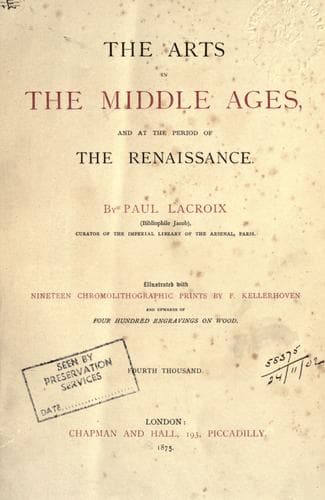
The Arts in the Middle Ages and at the Period of the RenaissanceJacob, P. L.
History
The Arts in the Middle Ages and at the Period of the Renaissance
Jacob, P. L.
Art, Medieval; Art, Renaissance; Middle Ages
In France was Jacques Callot, born in 1594, whose works were both
numerous and original, and enjoyed a somewhat popular celebrity; among
them the most worthy of remark are the “Temptation of St. Anthony,” the
“Fair of the Madonna d’Imprunette,” “The Garden” and the “Parterre,”
both scenes in Nancy; as well as several series, such as the “Miseries
of War,” &c. There were also Michael Lasne, born in 1596, who engraved a
number of historical portraits; and Etienne (Stephen) Baudet, who
reproduced eight large landscapes after Poussin.
[Illustration: Fig. 269.--“Ferdinand I., Brother of Charles V.” Engraved
by Bart. Beham in 1531.]
A separate notice is reserved for Jonas Suyderoef, born at Leyden in
1600, who, by combining the graver, the etching-needle, and aquafortis,
gave an exceptional character to his works. Among the two hundred
engravings by this master the most admired are the “Treaty of Munster,”
after Terburg; and the “Burgomasters of Amsterdam receiving the News of
the Arrival of Queen Mary of Medicis,” after De Keyser.
We are now touching closely upon, even if we have not already exceeded,
the limits to which we are prescribed by the scope of our notices; but
as the history of engraving does not present, like that of so many other
arts, the spectacle of a grievous decadence after a period of
brilliancy, we cannot without regret come to a conclusion, when mention
might still be made of many distinguished names among the engravers of
every country.
We should also scarcely be able to pass on to another subject without
having alluded to those men whose works belong, indeed, to the following
epoch, but the date of whose birth connects them with that we are
considering. We could not, in fact, assume to have treated of engraving
had we passed over in silence Van Dyck, Claude Lorraine, and Rembrandt
(Fig. 270), those greatest of masters who were equally celebrated for
painting and engraving. In truth, perhaps, we could not say anything of
them which would not be superfluous.
Public-domain text, read in full here on John Shaqi.
Reviews
Reviews
No reviews yet
Be the first to share your thoughts on this work.
Elsewhere in the archive
Join the Discussion
Join the discussion
Sign in to leave a comment or review.
Sign InorCreate an account