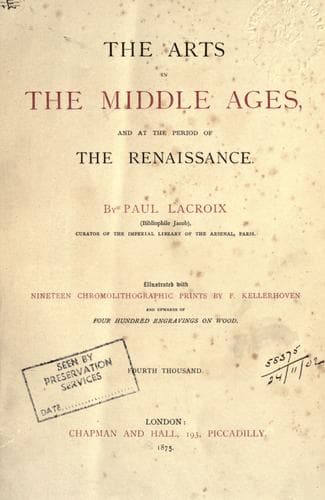
The Arts in the Middle Ages and at the Period of the RenaissanceJacob, P. L.
History
The Arts in the Middle Ages and at the Period of the Renaissance
Jacob, P. L.
Art, Medieval; Art, Renaissance; Middle Ages
Who is not acquainted with at least some few works by Van Dyck? This
celebrated pupil of Rubens has left in painting as many masterpieces as
canvases; and in engraving he knew how to give to his etching-needle so
much _verve_ and spirit, that his prints are perfect models to follow,
and have never been surpassed. Who is there that does not admire the
landscapes of Claude Lorraine, which are equally remarkable for the
light diffused over them, and the misty atmosphere that tempers its
brilliancy? We all know this master produced, as if for recreation,
certain engravings which for truth and melancholy (_mélancolic_) are
hardly surpassed by his marvellous paintings. And how can we speak of
Rembrandt without seeming to be commonplace? For his fertile and varied
talent no difficulty ever seemed to exist; a theme, the most simple and
common in appearance, becomes in his hands the basis of a masterly
conception; nature, to which he seemed to lend a new life, while seizing
upon its most striking realities, was for him an inexhaustible source of
powerful compositions.
The mention of these artists on the threshold of an epoch into which we
[Illustration: Fig. 270.--“Portrait of John Lutma, Goldsmith of
Groningen.” Designed and Engraved in aquafortis by Rembrandt.]
are precluded from following them, must suffice to convey some idea of
the height that art had attained during this century. We will, however,
enumerate after them a few names among foreign engravers. The Flemish
artists, Nicolas Berghem and Paul Potter, both great animal-painters,
have left some prints in aquafortis for the possession of which amateurs
contend; Wenceslaus Hollar, the Englishman,[46] engraved “The Queen of
Sheba,” after Veronese; to Cornelius Visscher, a Dutchman, we owe the
famous “Seller of Ratsbane;” and to Stefano della Bella, of Florence,
the “View from the Pont-Neuf, Paris.” Rupert, the Prince-Palatine
(nephew of Charles I. of England), was the inventor of the mezzo-tinto,
or black style of engraving; and William Faithorne, an Englishman,
engraved several portraits after Van Dyck. France also presents to our
notice some justly celebrated names. The views of towns by Israel
Silvestre, of Nancy, are very beautiful; François de Poilly, of
Abbeville, reproduced several pictures by Raphael; Jean Pesne, of Rouen,
himself a painter, engraved especially after Poussin; Antoine Masson, of
Orleans, has left a print of the “Pilgrims of Emmaus,” after the picture
by Titian, which is regarded as a _chef-d’œuvre_. Lastly, Robert
Nanteuil, of Rheims, the famous portrait-painter, engraved Péréfixe,
Archbishop of Paris, four times; the Archbishop of Rheims five times;
Colbert six times; Michel Le Tellier, Chancellor of France, ten times;
Louis XIV. eleven times, and Cardinal Mazarin fourteen times.
[Illustration: Fig. 271.--“The Holy Virgin.” Engraved by Aldegrever in
1527.]
SCULPTURE.
Public-domain text, read in full here on John Shaqi.
Reviews
Reviews
No reviews yet
Be the first to share your thoughts on this work.
Elsewhere in the archive
Join the Discussion
Join the discussion
Sign in to leave a comment or review.
Sign InorCreate an account