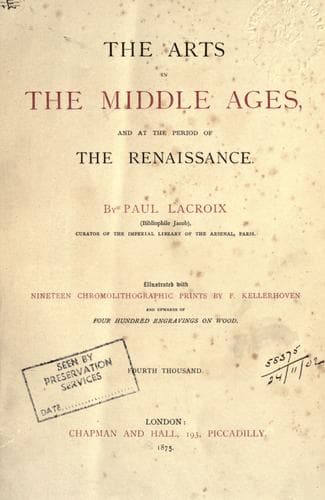
The Arts in the Middle Ages and at the Period of the RenaissanceJacob, P. L.
History
The Arts in the Middle Ages and at the Period of the Renaissance
Jacob, P. L.
Art, Medieval; Art, Renaissance; Middle Ages
Origin of Christian Sculpture.--Statues in Gold and
Silver.--Traditions of Antique Art.--Sculpture in
Ivory.--Iconoclasts.--Diptychs.--The highest Style of Sculpture
follows the Phases of Architecture.--Cathedrals and Monasteries
from the Year 1000.--Schools of Burgundy, Champagne, Normandy,
Lorraine, &c.--German, English, Spanish, and Italian
Schools.--Nicholas of Pisa and his Successors.--Position of French
Sculpture in the Thirteenth Century.--Florentine Sculpture and
Ghiberti.--French Sculptors from the Fifteenth to the Sixteenth
Century.
It is an indisputable fact that the epoch in which the Emperor
Constantine, by receiving baptism, effected the triumph of Christianity,
developed a kind of revival in the movement of the decorative arts, the
ideas of which were then exclusively directed to the exaltation of the
new faith. To construct numerous basilicas, to adorn them magnificently,
and by means of the chisel to embody in a material form the spiritualism
of the Gospel, were the objects of this pious monarch. Gold and silver
were the less spared, as marble was considered too common a substance in
which to represent the sacred personages of the divine hierarchy. At
Constantinople, in the basilica constructed by Constantine, there was
represented, on one side of the apse, a seated figure of our Saviour
surrounded by His twelve disciples; on the other side, Christ was
represented also sitting on a throne and accompanied by four angels, who
had precious stones of Alabanda, inlaid, to represent their eyes. All
these figures were life-size, and made of silver _repoussé_; each one
weighing from ninety to a hundred and ten pounds. In the same church, a
canopy representing the Apostles and cherubim in relief, of polished
silver, weighed more than two thousand pounds. But these splendours were
even eclipsed by those of the font of porphyry in which Constantine
received baptism from the hands of Bishop Sylvester. The part whence the
water flowed away was adorned with massive silver over an extent of five
feet, and for the purpose three thousand pounds of this precious metal
were employed. In the centre, columns of gold supported a lamp of the
same metal weighing fifty-two pounds, in which, during the feast of
Easter, two hundred pounds of perfumed oil were burnt. The water was
poured into the font through the image of a lamb of solid gold, weighing
thirty pounds. On the right was a life-size representation of our
Saviour, weighing a hundred and seventy pounds; on the left was a statue
of John the Baptist of the same size; while seven hinds of silver placed
around the font, and pouring water into the basin, harmonised in their
dimensions and materials with the other figures.
[Illustration: Fig. 272.--Altar of Castor (a Gallo-Roman Sculpture),
discovered in 1711 under the Choir of Notre-Dame, Paris.]
Public-domain text, read in full here on John Shaqi.
Reviews
Reviews
No reviews yet
Be the first to share your thoughts on this work.
Elsewhere in the archive
Join the Discussion
Join the discussion
Sign in to leave a comment or review.
Sign InorCreate an account