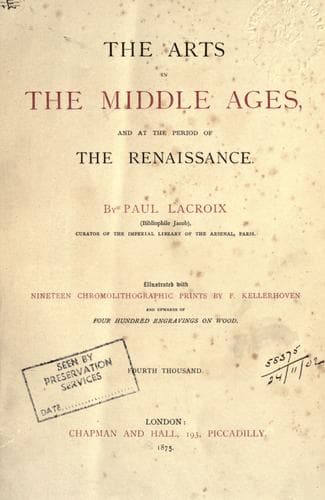
The Arts in the Middle Ages and at the Period of the RenaissanceJacob, P. L.
History
The Arts in the Middle Ages and at the Period of the Renaissance
Jacob, P. L.
Art, Medieval; Art, Renaissance; Middle Ages
In the eighth century, the epoch of the uprising of the Iconoclasts
against images of all kinds, Byzantine sculpture had acquired certain
well-marked characteristics: rigidness of outline, meagreness of form,
elongation of the proportions, combined with great profuseness of
costume; all was the expression of saddened resignation and costly
grandeur. The monumental statuary of this age has, however, almost
entirely disappeared, and we should be nearly destitute of any accurate
record as to the state of Art for a period of several centuries, were it
not for numerous diptychs which, to some extent, supply this want. Many
of these sacred diptychs were exquisitely wrought. Gori, in his “Trésor
des Diptyques,” written in Latin and published at Florence in 1759,
divides these monuments into four classes: diptychs intended to receive
the names of the newly baptised; those wherein were written the names of
the benefactors of the church, sovereigns, and popes; and those destined
to preserve the memory of the faithful who had died in the bosom of the
church (Fig. 276). Their outward surface generally represented some
scene taken from the Evangelists, in which Christ was especially
depicted as young and beardless, his head glorified with a nimbus
without a cross. The more these representations were condemned, the more
they who paid respect to them endeavoured to perpetuate their use. The
Greek artists, being unable to find a livelihood in their own country,
made their way into Italy in such numbers that the popes Paul I., Adrian
I., and Pascal I., erected monasteries to receive them. Owing to the
influence of this immigration, Art, which in the West was germinating in
an undecided state between a weak style of originality and an awkward
mode of imitation, was compelled to assume a character of its own, and
this necessarily was the Byzantine character; that is, a manner which
was firm, clear, and, in general, impressed with a certain imposing
nobility of style. This style attained all the more success by its being
illustrated by very eminent artists, whom Charlemagne patronised as
fully adequate to the magnificence of his ideas; and also because the
richness of ornament which this style combined with its work was likely
to render it pleasing to the populace.
The royal palaces of Aix-la-Chapelle, Goddinga, Attiniacum, and
Theodonis Villa, and the monasteries of St. Arnulph, Trèves, St. Gall,
Salzbourg, and Prüm felt the salutary influence which Charlemagne
exercised on all kinds of Art. Prior to 1793, in these various
localities precious remains were still to be seen, reaching back to the
eighth century; they testified to the fact that, apart from Byzantine
influence, and bearing the impress of a simple Christian sentiment,
sculpture still clung, owing to Lombard ascendancy, to some of the grand
traditions of antiquity.
Public-domain text, read in full here on John Shaqi.
Reviews
Reviews
No reviews yet
Be the first to share your thoughts on this work.
Elsewhere in the archive
Join the Discussion
Join the discussion
Sign in to leave a comment or review.
Sign InorCreate an account