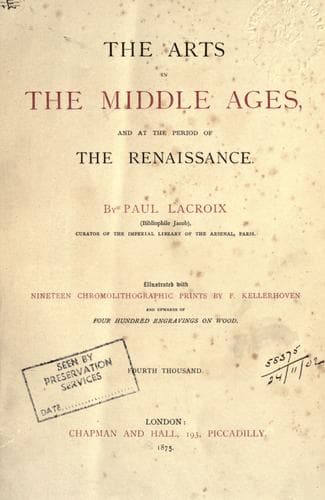
The Arts in the Middle Ages and at the Period of the RenaissanceJacob, P. L.
History
The Arts in the Middle Ages and at the Period of the Renaissance
Jacob, P. L.
Art, Medieval; Art, Renaissance; Middle Ages
This union of principles gave rise to a number of works bearing a
remarkable character. The foundation of the abbeys of St. Mihiel
(Lorraine), Isle-Barbe (near Lyons), of Ambernay and Romans; the
erection of several of the great monasteries in Alsace, Soissonnais,
Brittany, Normandy, Provence, Languedoc, and Aquitaine; the construction
of the
[Illustration: Fig. 276.--Diptychs in Carved Ivory of the Eleventh
Century. (M. Rigollot’s Collection, Amiens.)
The first compartment represents St. Remy, Bishop of Rheims,
healing a paralytic; the second, St. Remy healing a sick man by the
invocation of the sacrament on the altar; the third, St. Remy,
assisted by a holy bishop, baptising King Clovis in the presence of
Queen Clotilda, and receiving from the Holy Spirit the sacred
_ampulla_.
]
important churches of Metz, Toul, Verdun, Rheims, Autun, &c.; the
restorations which took place at the abbeys of Bèze, St. Gall, St.
Benignus of Dijon, Remiremont, St. Arnulphe-lès-Metz, and Luxeuil, were
of sufficient importance to occupy an immense number of artists,
architects, and sculptors, who, like the monk Gundelandus, abbot of
Lauresheim, handled the compasses and the mallet with as much authority
as the crucifix. Nothing could equal the splendour of some of the
monasteries, which were perfect centres of genius and skill, in which
all the Fine Arts united were a mutual assistance to one another;
directed, perhaps, by a master who was himself inspired by a feeling for
elevated production (Fig. 277).
Nevertheless, the smaller examples of sculpture and carving constituted
the principal work of the artists of the eighth century. In the
execution of any larger objects they were deterred by a dread of the
Iconoclasts, who still continued their course of destruction, neither
was it much less after the death of Charlemagne, owing to the civil wars
and invasions which, in every direction, put a stop to or ruined
architectural works. A shrine or an altar might perhaps be saved, but a
church-front or doorway could not be protected; and the hereditary
hatred with which princes pursued one another did not fail to be wreaked
on their effigies. At that time there were neither artists nor monks;
every one became a soldier, and the common peril gave some energy to our
alarmed ancestors.
Public-domain text, read in full here on John Shaqi.
Reviews
Reviews
No reviews yet
Be the first to share your thoughts on this work.
Elsewhere in the archive
Join the Discussion
Join the discussion
Sign in to leave a comment or review.
Sign InorCreate an account