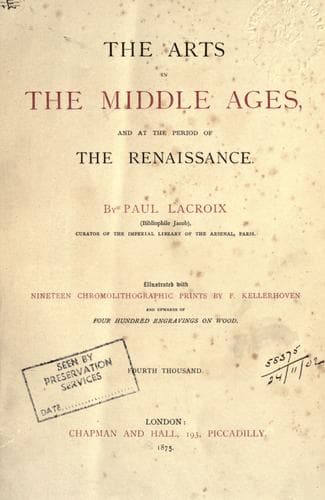
The Arts in the Middle Ages and at the Period of the RenaissanceJacob, P. L.
History
The Arts in the Middle Ages and at the Period of the Renaissance
Jacob, P. L.
Art, Medieval; Art, Renaissance; Middle Ages
But let us turn our eyes towards Italy. Venice had scarcely raised her
lofty dome ere Pisa aspired to have one also. Many a Tuscan ship,
launched upon the sea for conquests of a new kind, brought from Greece
an infinity of monuments, statues, bas-reliefs, capitals, friezes, and
various fragments; and the Tuscan people, the best organised race in
Europe for fully appreciating all the beauty of form, were called upon
to draw their inspiration from the relics of ancient works of Art. The
enthusiasm became general. In 1016, Buschetto, regarded as the first
architect of his time, undertook the building of the Cathedral of Pisa,
where ancient fragments are still conspicuous amid the works of more
modern creation: a kind of holographic testament the benefit of which
the followers of the art of Phidias have thus handed down to posterity.
The pupils of Buschetto, accepting the impulse of his masterly hand and
reproducing his ideas, soon spread all over the peninsula, and the
cathedrals of Amalfi, Pistoia, Siena, and Lucca arose, the Byzantine
character of which differed from the Lombard style presented by the
Cathedral of Milan. One might almost have fancied that the bosom of the
earth brought forth statues which, as if by enchantment, peopled every
pedestal; and that from heaven descended the ray which animated them
with their sublime expression. The art of casting in bronze, hitherto
almost unknown in Italy, became naturalised there as much as the art of
carving in stone.
While in the West the Arts were making such a spring, in the East they
had relapsed into the lowest stage of debasement, at the period when
Byzantium was simultaneously threatened by the Bulgarians and the
Crusaders; although for a time they had appeared to revive, owing to the
zeal of Basil the Macedonian, Constantine VIII., and some of their
successors. Eastern sculpture disappeared when the Latins sacked the
ancient capital of the first Christian emperor (1204).
At the approach of the thirteenth century, which was destined to be the
great age of Christian architecture and sculpture, artists no longer
looked, as they had hitherto done, towards Byzantium, they depended on
themselves; and although some hesitation might still be felt, they found
all round them models they could imitate, traditions they could follow,
and masters to whom they could listen. Christian art had now an
independent existence, and the various schools asserted their styles in
a way which became every day more clear, more powerful, and more
original.
“The style of the head of Christ at Amiens” (Fig. 281), says M.
Viollet-le-Duc, writing on this subject, “fully deserves the attention
of
[Illustration: Fig. 281.--“The _Beau Dieu d’Amiens_;” a Statue of Christ
in the Front of the Cathedral of Amiens. (Thirteenth Century.)]
Public-domain text, read in full here on John Shaqi.
Reviews
Reviews
No reviews yet
Be the first to share your thoughts on this work.
Elsewhere in the archive
Join the Discussion
Join the discussion
Sign in to leave a comment or review.
Sign InorCreate an account