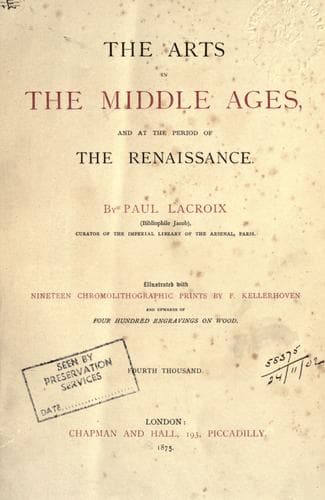
The Arts in the Middle Ages and at the Period of the RenaissanceJacob, P. L.
History
The Arts in the Middle Ages and at the Period of the Renaissance
Jacob, P. L.
Art, Medieval; Art, Renaissance; Middle Ages
sculptors. This carving is treated in the same way as the Greek heads
called Eginetic. There is the same simplicity of model, the same purity
of outline, the same style of execution, at once broad and delicate. It
well represents the features of Christ as a man: a blending of sweetness
with firmness, a gravity devoid of sadness.”
This is not the place to assert any minute comparisons between different
manners and styles; even the bare enumeration of the many monuments to
which this fervent age gave birth might prove wearisome. We call it a
“fervent age,” and fully are we justified, for, at a time when a whole
world of artist-sculptors of ornaments and figures were devoting
themselves to the most delicate and marvellous works of sculpture (Fig.
282), none seemed desirous of displaying his own personal distinction.
We find, for instance, numerous sculptors setting aside all claim to
individual merit, and carrying this self-denial so far that, instead of
their own names, they inscribed that of the Virgin Mary on the carvings
of the churches which they had enriched with their finest works: “Hoc
panthema pia cælaverat ipsa Maria.”
In Germany, Christian art became specially enthroned in Saxony; and
Dresden, which has been justly styled the German Athens, can date back
her architecto-sculptural adornments to the tenth century. On the banks
of the Rhine, at Cologne, Coblentz, and Mayence, we find again the
school of Saint-Gall, which, having been planted in 971, under the
auspices of Notker, Bishop of Laodicea, left its stamp, during a period
of two centuries, in a series of remarkable works.
England, as early as the seventh century, had called to her aid some of
the French “masters in stone” and best workmen, and she subsequently
continued to do so for the building and ornamentation of her finest
religious edifices. William of Sens, a very skilful artist (_artifex
subtilissimus_), proceeded, in 1176, to rebuild Canterbury Cathedral.
Norman and French artists also restored the abbeys of Croyland and
Wearmouth, and York Cathedral, already enriched with Byzantine and
French sculpture.
Spain and Portugal, the soil of which had long been the theatre of an
inveterate conflict between two races embracing two irreconcilable
religions, were destined to inherit from these very struggles the
creation of a singularly characteristic style of art. In adopting the
Byzantine style, the Moors had deprived it of its character of simple
earnestness, and made it to harmonise with the tendencies of their
refined sensualism. Even when Christian art was able to exercise an
undivided rule, it could not fail to be influenced by the buildings
erected by the Moors; and the fact that this alliance of architectural
and sculptural styles succeeded in producing masterpieces is well
attested by the cathedrals of Cuenca, Vittoria, and some portions of
those of Seville, Barcelona, and Lugo in Galicia.
Public-domain text, read in full here on John Shaqi.
Reviews
Reviews
No reviews yet
Be the first to share your thoughts on this work.
Elsewhere in the archive
Join the Discussion
Join the discussion
Sign in to leave a comment or review.
Sign InorCreate an account