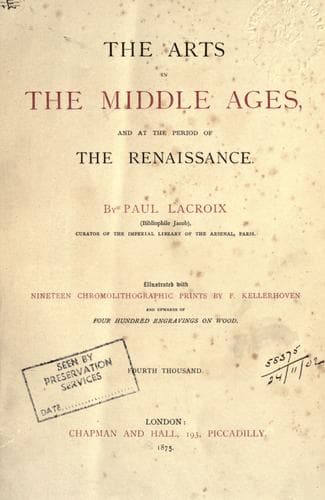
The Arts in the Middle Ages and at the Period of the RenaissanceJacob, P. L.
History
The Arts in the Middle Ages and at the Period of the Renaissance
Jacob, P. L.
Art, Medieval; Art, Renaissance; Middle Ages
of the ancient temples, it generally happened that the architect,
conforming himself to new requirements, endeavoured, by a prudent return
towards the traditions of the past, to avoid those striking
incongruities which would have deprived of all their value the
magnificent materials he had at his disposal. Hence arose a style still
undecided; hence mixed creations, which it will suffice merely to
mention. Then we must not forget--to say nothing of the case in which,
as in the old Roman city, Christian basilicas might be built with the
marble of heathen sanctuaries--the monuments of this same Rome were
still the only models that presented themselves for imitation. Finally,
for this architecture which the Christian religion was to create as its
own, it was obvious there would be an infancy, an age of groping in the
dark and of uncertainty; and at length that there should be a separation
from the past, and a gradually experienced feeling of individual
strength. (Fig. 299.)
This infancy lasted about five or six centuries; for it was only about
the year 1000 that the new style--which we see at first made up of
“recollections” and weak innovations--assumed an almost determinate
form. This is the period called Norman,[49] which, according to M.
Vaudoyer, has left us some monuments that are “the noblest, the
simplest, and the severest expression of the Christian temple.”
[Illustration: Fig. 297.--The Church of St. Agnes, at Rome, Latin style
(Fifth Century). Restored and debased in the Seventeenth Century.]
[Illustration: Fig. 298.--The Church of St. Martin, at Tours (Sixth
Century). Rebuilt or restored in the Eleventh Century.]
“Three years after the year 1000, which was supposed was to be the last
year of the world,” says the monk Raoul Glaber, “churches were renewed
in nearly every part of the universe, especially in Italy and in Gaul,
although the greater number were still in a condition good enough to
require
[Illustration: Fig. 299.--Remains of the Church of Mouen, in Normandy.
Architecture of the Fifth or Sixth Century.]
Public-domain text, read in full here on John Shaqi.
Reviews
Reviews
No reviews yet
Be the first to share your thoughts on this work.
Elsewhere in the archive
Join the Discussion
Join the discussion
Sign in to leave a comment or review.
Sign InorCreate an account