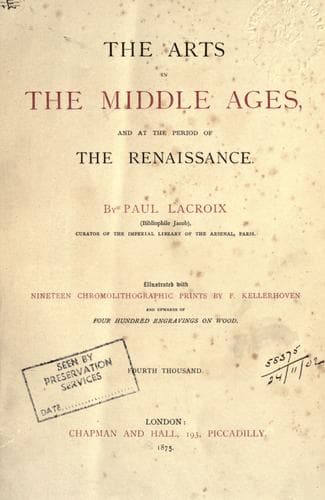
The Arts in the Middle Ages and at the Period of the RenaissanceJacob, P. L.
History
The Arts in the Middle Ages and at the Period of the Renaissance
Jacob, P. L.
Art, Medieval; Art, Renaissance; Middle Ages
no repairs.” “It was to this period, that is to say, the eleventh
century,” adds M. Vaudoyer, “must be assigned the greater number of the
ancient churches of France, grander and more magnificent than all those
of preceding centuries; it was then, also, the first associations of
builders were formed, whereof the abbots and the prelates themselves
formed a portion, and which were essentially composed of men bound by a
religious vow; the Arts were cultivated in the convents, the churches
were built under the direction of bishops; the monks co-operated in
works of all kinds.... The plan of the Western churches preserved the
primitive arrangement of the Latin basilica--that is, the elongated form
and the lateral galleries; the most important modifications were the
lengthening of the choir and of the galleries, or of the cross, a free
passage established round the apse (Fig. 300); and, lastly, the
combination of chapels, which grouped themselves around the sanctuary.
In the construction the isolated columns of the nave are sometimes
replaced by pillars, the spaces between which are filled up with
semicircular arches,
[Illustration: Fig. 300.--Notre-Dame, Rouen, ogival style. (Thirteenth
Century.)]
and a general system of vaulted roofs is substituted for the ceilings
and timber roofs of the ancient Latin basilicas.... The use of bells,
which was but sparingly adopted in the East, contributed to give to the
churches of the West a character and an appearance quite their own, and
which they owe particularly to those lofty towers that had become the
essential part of their façade.”
The façade itself is generally of great simplicity. We enter the edifice
by one of three doors, above which runs, in most cases, a little gallery
formed of very small columns close to each other, supporting a range of
arcades; and these arcades are often ornamented with statues, as we find
in the church of Notre-Dame at Poitiers, which--together with the
churches of Notre-Dame des Doms, at Avignon; of St. Paul, at Issoire; of
St. Sernin, at Toulouse; of Notre-Dame du Port, at Clermont, &c.--may be
considered as one of the most complete specimens of Norman architecture.
In churches of this style, as for instance those of St. Front, at
Périgueux; of Notre-Dame, at Puy en Velay; of St. Etienne, at Nevers,
are seen also some cupolas; but we must not forget that the Byzantine
architects, whose migrations towards the West were constantly taking
place at this period, could not fail to leave traces of their
wanderings, and we must acknowledge that, especially in our own country
(France), where Oriental influence was never more than partial, the
union of the two architectonic principles produced the happiest results.
The Cathedral of Angoulême, for example, is justly regarded as one of
the edifices in which Oriental taste harmonises the best with the Norman
style.
Public-domain text, read in full here on John Shaqi.
Reviews
Reviews
No reviews yet
Be the first to share your thoughts on this work.
Elsewhere in the archive
Join the Discussion
Join the discussion
Sign in to leave a comment or review.
Sign InorCreate an account