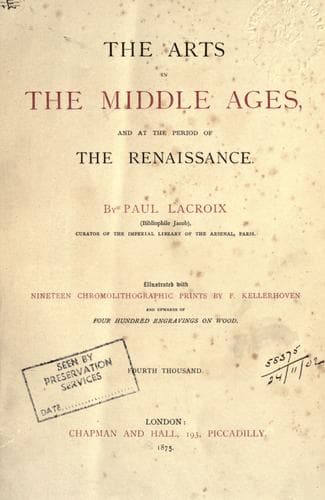
The Arts in the Middle Ages and at the Period of the RenaissanceJacob, P. L.
History
The Arts in the Middle Ages and at the Period of the Renaissance
Jacob, P. L.
Art, Medieval; Art, Renaissance; Middle Ages
From the twelfth to the thirteenth century the transition took place.
The Norman style, which is distinguished by its round arch, maintained
the struggle with the Gothic style, of which the ogive is the original
mark. In the churches of this period we find also, with regard to the
ground-plan of edifices, the choir assuming larger dimensions,
necessitated no doubt by increased ceremonials in the services. The
Latin cross, which was the ground-plan whereon up to this time the
greater number of sanctuaries were built, ceased to indicate as
precisely as heretofore its outlines; the nave was raised considerably
in height, the lateral chapels were multiplied, and often broke the
perspective of the side-aisles; bell-towers assumed greater importance,
and the placing of immense organs above the principal entrance gave rise
to a new system of elevated galleries in this part of the building.
[Illustration: Fig. 304.--Details of the Portal of St. Trophimus, at
Arles. (Twelfth Century.)]
The churches of St. Remy, Rheims; of the Abbey of St. Denis; of St.
Nicholas, Blois; the Abbey of Jumiéges; and the Cathedral of
Châlons-sur-Marne, are the principal examples of the architecture of the
mixed style.
[Illustration: Fig. 305.--Cloister of the Abbey of Moissac, Guyenne.
(Twelfth Century.)]
It should be remarked that for a long while, in the north of France, the
pointed arch had prevailed almost entirely over the round arch, at the
time when, in the south, Norman tradition, blended with the Byzantine,
still continued to inspire the builders. Nevertheless, the demarcation
cannot be rigorously established, for, at the time when edifices of the
purest Norman style showed themselves in our (French) northern counties
(as, for example, the Church of St. Germain-des-Prés, and the apse of
[Illustration: DECORATION OF LA SAINTE CHAPELLE, PARIS.
Thirteenth Century.]
St. Martin-des-Champs, Paris), we find, at Toulouse, at Carcassonne, at
Montpellier, the most remarkable specimens of the Gothic style. At last
Gothic architecture gained the day. “Its principle,” says M. Vitet, “is
in emancipation, in liberty, in the spirit of association and commerce,
in sentiments quite indigenous and quite national: it is homely, and
more than that, it is French, English, Teutonic, &c. Norman
architecture, on the contrary, is sacerdotal.”
And M. Vaudoyer adds: “The rounded arch is the determinate and
invariable form; the pointed arch is the free and indefinite form which
lends itself to unlimited modifications. If, then, the Pointed style has
no longer the austerity of the Norman, it is because it belongs to that
second phase of all civilisation, in which elegance and richness replace
the strength and the severity of primordial types.”
Public-domain text, read in full here on John Shaqi.
Reviews
Reviews
No reviews yet
Be the first to share your thoughts on this work.
Elsewhere in the archive
Join the Discussion
Join the discussion
Sign in to leave a comment or review.
Sign InorCreate an account