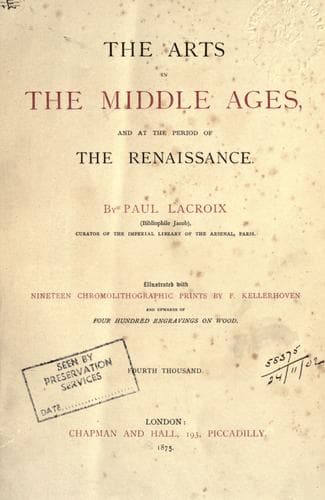
The Arts in the Middle Ages and at the Period of the RenaissanceJacob, P. L.
History
The Arts in the Middle Ages and at the Period of the Renaissance
Jacob, P. L.
Art, Medieval; Art, Renaissance; Middle Ages
It was, moreover, at this period that architecture, like all the other
arts, left the monasteries to pass into the hands of lay architects
organised into confraternities, who travelled from place to place, and
thus transmitted the traditional types; the result of this was that
buildings raised at very great distances from each other presented a
striking analogy, and often even a complete similitude to each other.
There has been much discussion not only on the origin of the pointed
arch, but also as to the beauty and excellence of its form. According to
some it was suggested by the sight of many arches interlaced, and only
constituted one of those fantastical forms which an art in quest of
novelty adopts; others, among whom is M. Vaudoyer, attribute to it the
most remote origin, by making it result quite naturally in the first
attempts at building in stone,--“from a succession of courses of stone
so arranged that each overhung the other;” or else in wooden
constructions, “from the greater facility there was in forming with
beams a pointed rather than a perfectly rounded arch;” others consider
the adoption of the Pointed style, as we said above, as nothing but a
proof of the religious independence succeeding the rigid faith of
earlier days. A third opinion, again, is that of M. Michiels, who looks
on the Pointed style as in some sort an inevitable result of the
boldness of the Norman, and who considers the Gothic, of which it is the
characteristic, as “expressing the spirit of a period when religious
feeling had attained its most perfect maturity, and Catholic
civilisation produced its sweetest and most agreeable fruits.”
[Illustration: Fig. 306.--Mayence Cathedral. Rhenish Norman. (Twelfth
and Thirteenth Centuries).]
Whatever may be the merits of these different opinions, into the
discussion of which we need not enter, it is now generally assumed that
the Pointed style, properly so called, sprang up first within the limits
of the ancient Ile-de-France, whence it propagated itself by degrees
towards the southern and eastern provinces.
M. Michiels, agreeing on this point with the celebrated architect
Lassus, points out that it would be as difficult to attribute the
creation of this style to Germany as to Spain. It was in the thirteenth
century that the finest Gothic buildings appeared in France; while in
Germany, except the churches built, as it were, on the French frontier,
we find nothing at that period but Norman churches (Fig. 306); and it is
reasonable to suppose that, if we owed the general adoption of the
pointed arch to Spain, the introduction of it would have been gradually
made through that part of the country situated beyond the Loire, where,
however, the Norman style continued to be in great favour when it was
almost entirely abandoned in the north of France.
Public-domain text, read in full here on John Shaqi.
Reviews
Reviews
No reviews yet
Be the first to share your thoughts on this work.
Elsewhere in the archive
Join the Discussion
Join the discussion
Sign in to leave a comment or review.
Sign InorCreate an account