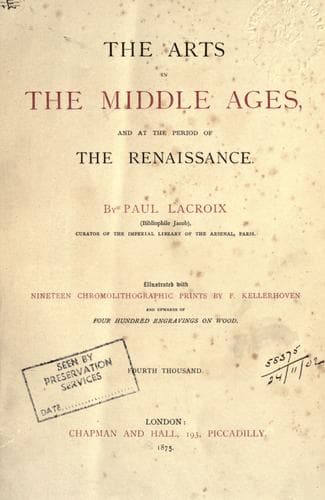
The Arts in the Middle Ages and at the Period of the RenaissanceJacob, P. L.
History
The Arts in the Middle Ages and at the Period of the Renaissance
Jacob, P. L.
Art, Medieval; Art, Renaissance; Middle Ages
The Christianity of the Middle Ages had then been able to find in the
Gothic style a tongue as tractable as it was energetic, as simple as it
was ingenious, which, for the pious excitement of souls, was to declare
to the senses all its ineffable poetry. But as the unbounded faith, of
which it was the faithful organ, was on the next dawn of its most ardent
aspirations about to decline, so this splendid style was almost as soon
to lose its vigour, and to exhaust itself in the unrestrained
manifestation of its power.
Springing into existence with the warm enthusiasm of the first Crusades,
the Pointed style seems to follow in its different phases the decline of
faith in the time of these adventurous enterprises. It began by a
sincere outburst, and was produced by a bold, unshackled genius; then a
factitious or reflected ardour gave birth to elaborateness and
mannerism; then the fervent zeal and the artistic sentiment dwindled
away: this is the decadency.
Gothic art raised itself in less than a century to its culminating
point; within two centuries more it was to reach the fatal point where
it would begin to decline. The thirteenth century saw it in all its
glory, with the edifices we have mentioned; in the fourteenth it had
become the Florid or _Rayonnant_ Gothic, which produced the churches of
St. Ouen at Rouen, and of St. Etienne at Metz. “Then,” says M. A.
Lefèvre, one of the latest historians of architecture, “no more walls;
everywhere open screen-work supported by slender arcades; no more
capitals, rows of foliage imitated directly from nature; no more
columns, lofty pillars ornamented with round or bevelled mouldings. As
yet, however, there was nothing weakly in its extreme elegance; slim and
delicate without being gaunt, the Florid style did not in the least
disfigure the churches of the thirteenth century, which it bounded and
decorated.
“But after the _Rayonnant_ Gothic came the _Flamboyant_, which, always
under the pretext of lightness and grace, denaturalises the ornaments,
the forms, and even the proportions of the architectural members. It
effaces the horizontal lines which used to give two stories to the
windows of the nave, fills up the nave with irregular compartments,
_cœurs_, _soufflets_, and _flammes_; suppresses the angles of the
pillars and sharpens the mouldings; leaves even to the most massive
supports nothing but an undulating, vanishing, impalpable form, where
shadow cannot fix itself; changes the lancet-arches into braces, or into
flat-arched vaults more or less depressed, and the florid ornamentation
of the pinnacles into whimsical scrolls. It reserved all its riches for
accessory or exterior decorations, stalls, pulpits, hanging key-stones,
running friezes, rood-screens, and bell-towers. Visible decadency of the
whole corresponds with great progress in details.” (Fig. 313.)
Public-domain text, read in full here on John Shaqi.
Reviews
Reviews
No reviews yet
Be the first to share your thoughts on this work.
Elsewhere in the archive
Join the Discussion
Join the discussion
Sign in to leave a comment or review.
Sign InorCreate an account