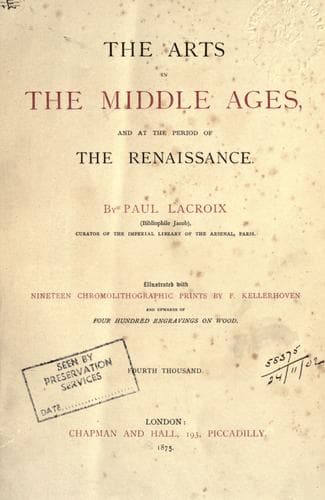
The Arts in the Middle Ages and at the Period of the RenaissanceJacob, P. L.
History
The Arts in the Middle Ages and at the Period of the Renaissance
Jacob, P. L.
Art, Medieval; Art, Renaissance; Middle Ages
space, and the landscape stretching out around them below; we must
follow attentively with our eye the strikingly bold outlines which the
turrets, the ornamented gables, the _guivres_, the tops of the
bell-towers trace upon the sky. This done, we should yet have paid but a
brief tribute of attention to these prodigious edifices. What, then, if
we wished to devote sufficient time to the ornamentation of the details
(Figs. 309 to 312)? if we desired to obtain a tolerably exact idea of
the people from the statues which swarm from the porch to the pinnacle,
and of the _flora_ and _fauna_, real or ideal, that give movement to
every projection or animate every wall? if one counted on success in
finding out the key to all the crossings and intersections of the
lines, of the well-adjusted conceptions which, while they deceive the
eye, contribute to the majesty or the solidity of the whole? if,
finally, we were most careful not to lose any one of the multifarious
thoughts that have been fixed in the stones of the gigantic edifice? The
mind becomes confused; and certainly the effect produced by so much
imagination and so much enterprise, by so much skill and taste,
wonderfully elevates the soul, which searches with more love after the
Creator when it sees such a work proceeding from the hands of the
creature.
[Illustration: Fig. 311.--Vestige of the Architecture of the Goths at
Toledo. (Seventh Century.)]
[Illustration: Fig. 312.--Capital in the Church of the Célestins
(destroyed), Paris. (Fourteenth Century.)]
When you approach the Gothic church, when you stand beneath its lofty
roof, it is as if a new country were receiving you, possessing you,
casting around you an atmosphere of subduing reverie in which you feel
your wretched servitude to worldly interests vanishing away, and you
become conscious of more solid, more important ties, springing up in
you. The Deity whom our finite nature can figure to ourselves seems in
fact to inhabit this immense building, to be willing to put himself in
direct communion with the humble Christian who approaches to bow down
before Him. There is nothing in it of the human dwelling-place--all
relating to our poor and miserable existence is here forgotten; He for
whom this residence was constructed is the Strong, the Great, the
Magnificent, and it is from a paternal condescension that He receives us
into His holy habitation, as weak, little, miserable. It is the ideal of
the faith which is realised; all the articles of the belief in which we
have been brought up are here embodied before our eyes; it is, lastly,
the chosen spot where the meeting of mortal nothingness and Divine
Majesty is quietly accomplished.
Public-domain text, read in full here on John Shaqi.
Reviews
Reviews
No reviews yet
Be the first to share your thoughts on this work.
Elsewhere in the archive
Join the Discussion
Join the discussion
Sign in to leave a comment or review.
Sign InorCreate an account