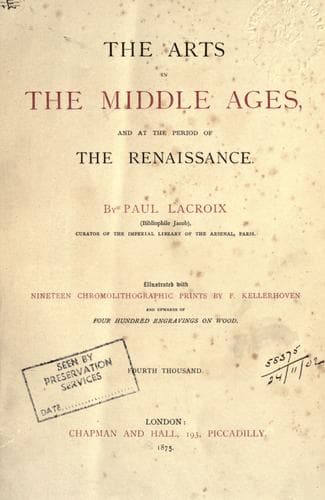
The Arts in the Middle Ages and at the Period of the RenaissanceJacob, P. L.
History
The Arts in the Middle Ages and at the Period of the Renaissance
Jacob, P. L.
Art, Medieval; Art, Renaissance; Middle Ages
In Germany, where for a time it reigned almost exclusively, Gothic art
established the cathedrals of Erfurt, of Cologne, Fribourg, and of
Vienna; then it died away in the growth of the _Flamboyant_ style. In
England, after having left some magnificent examples of pure
inspiration, it found its decline in the attenuated meagreness and the
complicated ornamentation of the style called _Perpendicular ogival_. If
it penetrated also into Spain, it was to contend with difficulty against
the mighty Moorish school, which had too many imposing _chefs-d’œuvre_
in the past to surrender without resistance the country of its former
triumphs (Fig. 324). In Italy it clashed not only with the Latin and
Byzantine schools, but also with a style that, just beginning to form
itself, was soon to dispute with it the empire of taste, and to dethrone
it in that very land which had been its cradle. The cathedrals of
Assisi, of Siena, of Milan, are the splendid works in which its
influence triumphed over local traditions and over the _Renaissance_
that was preparing to follow; yet we must not think that it succeeded
even there in rendering itself absolutely the master, as it had done on
the Rhenish or British territories. Sacrifices were made in its favour;
but these sacrifices did not amount to an entire immolation.
[Illustration: Fig. 322.--Doorways of the Hôtel de Sens, at Paris; the
last remaining portion of the Hôtel Royal de
Saint-Pol, built in the reign of Charles V. (Fourteenth Century.)]
When we use the word _Renaissance_, we seem to be speaking of a return
to an age already gone by, of the resurrection of a period that had
passed away. It is not strictly in this sense that the word must be
understood in the present instance.
[Illustration: Fig. 323.--Belfry of Brussels (Fifteenth Century), from
an engraving of the Seventeenth Century.]
Inheriting from of old the artistic temperament of Greece, rather than
spontaneously creating of herself any style, Italy, among all the
nations of Europe, was the country which had most successfully resisted
the profound
[Illustration: Fig. 324.--Interior of the Palace of the Alhambra, at
Granada.--(Thirteenth Century.)]
darkness of barbarism, and the first on which the light of modern
civilisation shone.
Public-domain text, read in full here on John Shaqi.
Reviews
Reviews
No reviews yet
Be the first to share your thoughts on this work.
Elsewhere in the archive
Join the Discussion
Join the discussion
Sign in to leave a comment or review.
Sign InorCreate an account